




Excellence in Pediatrics is a non-profit association dedicated to advancing pediatric healthcare.
Rue des Vignerons 18, 1110 Morges 1 (VD), Switzerland
email: secretariat@ineip.org
tel. +41 43 21 55 937


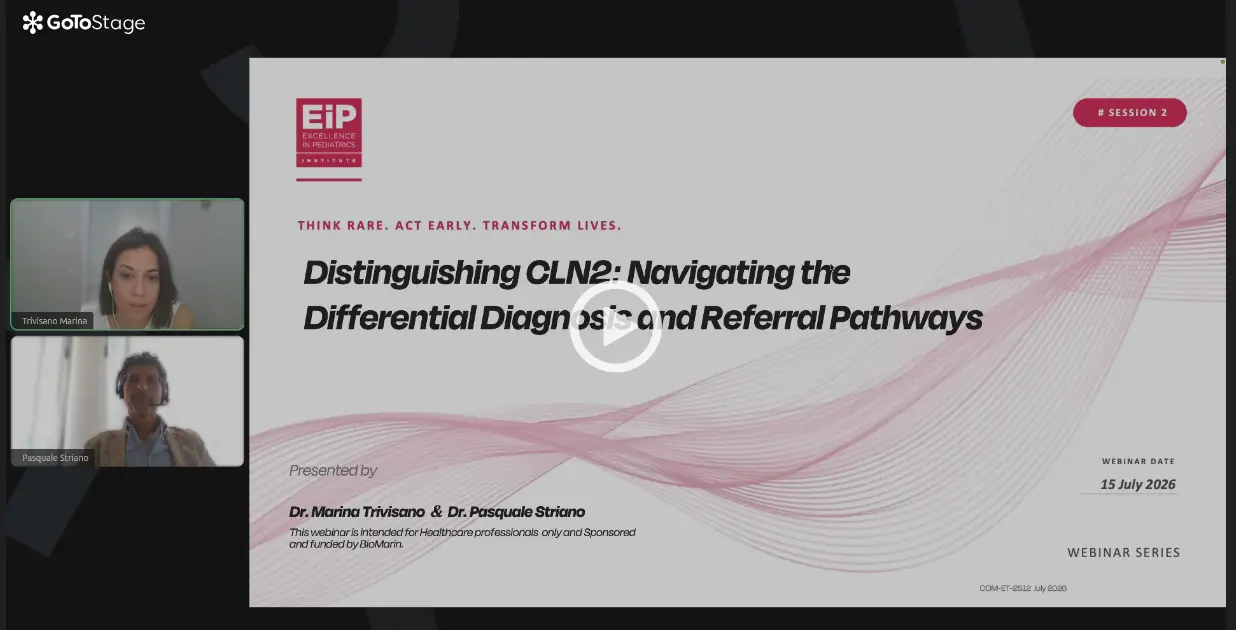
A 40-minute expert webinar on the multidisciplinary management and treatment of CLN2 (Batten) disease — how enzyme replacement therapy with cerliponase alfa, supportive care and coordinated multidisciplinary team input work together across the disease course, and why early diagnosis shapes long-term outcomes. Dr Dipak Ram (paediatric neurologist, Royal Manchester Children’s Hospital) draws on the Manchester CLN2 service — at its peak 19 children on enzyme replacement therapy — with practical cases on recognising reversible causes of decline, feeding and seizure management, and end-of-life care. For paediatricians, paediatric neurologists and metabolic teams.


CLN2 disease is a form of Batten disease — a lysosomal storage disorder in which deficiency of the TPP1 enzyme allows lipofuscin to build up and become toxic to the nervous system and the retina. Its classical form follows a characteristic and rapid trajectory: speech delay in almost every child, followed by afebrile seizures (which may be focal, myoclonic or tonic-clonic), then ataxia and loss of independent walking between about three and five years of age, visual decline and blindness, with most untreated children dying within the first decade of life. Because regression begins soon after the seizures start, the window to diagnose early and act is narrow. There is no cure, but progression can be slowed. Enzyme replacement therapy with cerliponase alfa — a recombinant form of the TPP1 enzyme delivered by intraventricular infusion every two weeks — modifies the disease course, and children treated early, or pre-symptomatically because of an affected sibling, do markedly better. Dr Dipak Ram sets out when to suspect and test for CLN2: speech delay combined with new afebrile seizures, myoclonic jerks in early childhood, an affected sibling, or developmental regression and loss of skills. The fastest confirmatory test is usually a TPP1 enzyme activity assay (turned around in 24–48 hours in UK metabolic laboratories), with a rapid epilepsy gene panel that includes the TPP1 gene as an alternative. The heart of the session is multidisciplinary management, drawn from the Manchester CLN2 service. No single clinician can manage these children: care brings together paediatric neurology and metabolic teams, neurosurgeons for the intraventricular device, specialist nurses who deliver the infusions, clinical psychologists, physiotherapists and occupational therapists, dietitians and speech and language therapists, coordinated in a one-stop clinic with the local team kept involved. Treated children follow a modified, fluctuating (non-linear) course and can develop a choreoathetoid movement disorder, so decline should prompt a search for a reversible cause. Three cases illustrate the point — severe dystonia driven by reflux, faltering nutrition helped by gastrostomy, and drowsiness caused by non-convulsive status — each reversed by treating the underlying problem. The webinar also covers giving the diagnosis well, watching the key markers of progression, recognising when decline is genuine, involving palliative care early, and the goal of lowering the average age at diagnosis from around four-and-a-half years towards three years.

CLN2 is a complex, progressive condition that no single clinician can manage alone. Care combines the neurometabolic team (paediatric neurology and metabolic consultants) with neurosurgeons, who insert and troubleshoot the intraventricular infusion device; specialist nurses, who deliver the fortnightly infusions and monitor the child; clinical psychologists, who support families through the diagnosis and a progressive illness; physiotherapists and occupational therapists for tone and mobility; and dietitians and speech and language therapists for feeding and swallow safety. In Manchester these children are seen in a one-stop clinic so the whole team can answer the family’s questions in a single visit, with the local paediatric team kept involved throughout.
There is no cure — CLN2 is a progressive neurodegenerative condition and damaged neurons cannot be repaired — so treatment aims to slow progression. The disease-specific therapy is enzyme replacement therapy with cerliponase alfa, a recombinant form of the TPP1 enzyme, given by intraventricular (intracerebroventricular) infusion every two weeks. Children on treatment show a modified, slower and often fluctuating disease course rather than the steady decline seen without treatment. Supportive care is equally important: managing seizures, dystonia, feeding and other comorbidities, because enzyme replacement alone does not address these and does not treat the visual decline.
The single fastest test is usually a TPP1 enzyme activity assay — in UK metabolic laboratories (Birmingham, Manchester and London) this can be turned around in roughly 24–48 hours. Where enzyme testing is slower, a rapid epilepsy gene panel that includes the TPP1 gene will identify CLN2 in almost all cases within a few weeks. Testing should be considered when a child has speech delay together with new afebrile seizures, myoclonic jerks in early childhood, developmental regression or loss of skills, or an affected sibling. Early diagnosis matters because enzyme replacement takes time to work and preserves remaining function rather than reversing damage — the service is working to move the average age at diagnosis from about four-and-a-half years towards three years.
In a child on enzyme replacement therapy, decline should not be assumed to be end-stage disease — treated children retain considerable reversibility, so a reversible cause should always be sought first. Common culprits include gastro-oesophageal reflux (which can drive severe dystonia), chest or urinary infections, hip problems, poor nutrition during intercurrent illness, and unrecognised seizures or non-convulsive status. The webinar’s cases show dramatic improvement once reflux, nutrition (via a gastrostomy) or seizures were treated. Clinicians should watch the key markers of progression — loss of independent walking, slowing speech with swallow-safety concerns, and visual decline — and keep open, two-way communication with the local paediatrician and school, who may notice subtle changes the specialist centre misses. When reversible causes are excluded and the decline is genuine, palliative care is involved early and leadership often shifts to the local team.

This content is intended for healthcare professionals only. The views expressed are those of the presenters and do not necessarily reflect those of Excellence in Pediatrics; their inclusion does not imply endorsement. The content is provided for educational purposes only and does not constitute medical advice or replace independent clinical judgement.