
.webp)




Excellence in Pediatrics is a non-profit association dedicated to advancing pediatric healthcare.
Rue des Vignerons 18, 1110 Morges 1 (VD), Switzerland
email: secretariat@ineip.org
tel. +41 43 21 55 937


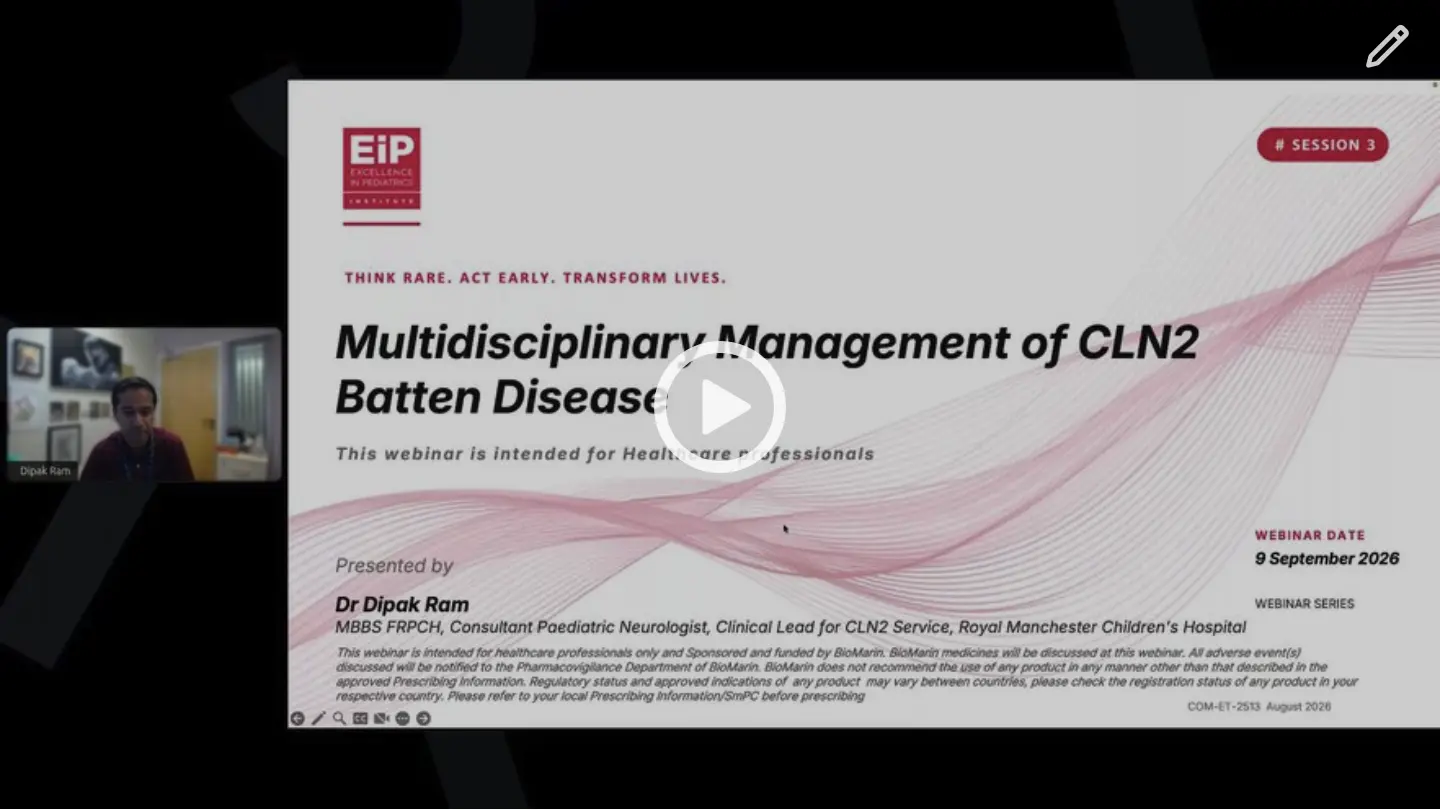
A 60-minute expert webinar on distinguishing CLN2 (Batten) disease from the common developmental, behavioural and epilepsy presentations it first mimics. Dr Marina Trivisano and Dr Pasquale Striano set out the early red flags — language delay, a first unprovoked seizure and developmental regression — and a practical differential-diagnosis and referral pathway aimed at closing the ~22-month gap between first symptom and diagnosis. For paediatricians, paediatric neurologists and metabolic teams.


CLN2 disease (late-infantile neuronal ceroid lipofuscinosis type 2, a form of Batten disease) is a rapidly progressive neurodegenerative disorder caused by deficiency of the TPP1 enzyme. It declines predictably from around three years of age, yet the median age at diagnosis is about 4.5 years — roughly 22 months after the first symptom — and because enzyme replacement therapy aims to limit neuronal storage, that lost time means lost neurological function. Dr Pasquale Striano explains why CLN2 is missed: in isolation, each early feature — language delay, a first unprovoked seizure, clumsiness, behavioural change — looks like a common paediatric problem. It is recognised longitudinally, from the trajectory of change, and true regression should always reopen the diagnosis. When two or more red flags overlap, disease-specific testing is justified without waiting for the full phenotype — enzyme activity and broad molecular testing (including the TPP1 gene) in parallel. Dr Marina Trivisano reviews the earliest biomarkers: the low-frequency photoparoxysmal response on EEG and posterior white-matter change with cerebellar atrophy on brain MRI, illustrated with three cases. The message: think rare earlier, at the first seizure.
After viewing this webinar, participants will be able to:
This transcript was produced by automatic speech recognition and edited for readability; it has not been fully verified word-for-word. It may contain errors — particularly with names, technical terms, and where English is a speaker’s second language. It is provided as a convenience only. For anything clinical, please refer to the video recording to hear exactly what the expert said.
Dr Marina Trivisano: Good morning to everyone, and welcome to this webinar on NCL type 2 (CLN2) disease. It is focused mainly on the differential diagnosis and the pathway to reaching an early diagnosis in this rare disorder. Over the next hour, Dr Pasquale Striano and I will introduce the disease and then discuss the diagnostic tests and treatment. You can submit questions at any point via the chat, and there will be time for discussion at the end.
The first topic is the importance of early diagnosis and the pitfalls in reaching it. CLN2 is a neurodegenerative disorder associated with a predictable and rapid decline of motor and cognitive function. This figure, based on data collected in the DEM-CHILD Registry, scores motor and language function (a combined maximum of six). From around three years of age — usually when the first symptom appears — there is a rapid decline, with loss of ambulation and loss of language. Unfortunately there is an important delay in diagnosis: the median age at diagnosis is about 4.5 years, roughly 22 months after the first symptom. Our goal is to reach the diagnosis at the first symptoms of the disease, in order to get the best result from treatment.
The neurodegenerative nature of the disorder is illustrated by the course of one of our patients. At three years of age she was able to build a tower with no dysmetria and no problem with coordination. Later she lost ambulation, developed tetraparesis, required a gastric tube for feeding problems, developed a dystonic movement disorder, and became blind. That is the natural history of the disease.
Why is early diagnosis so important? It changes clinical management, including the choice of anti-seizure medication. Crucially, an early diagnosis allows enzyme replacement therapy to be started earlier, before the accumulation of storage material in neurons. It avoids long, exhausting diagnostic journeys for families, enables participation in clinical trials, and gives access to targeted therapy. And because CLN2 is a genetic disorder with autosomal recessive inheritance — around a 25% risk of recurrence in a family — a confirmed diagnosis is also important for genetic counselling.
A word on language and developmental delay. Developmental delay is common in children, but about 85% of patients with CLN2 disease have a history of language delay before the onset of epilepsy. So the first key message is this: when a child presents with an unprovoked epileptic seizure between two and four years of age and has a history of language delay, it is important to test enzyme activity and to think of CLN2 disease.
Dr Pasquale Striano: Thank you, Marina. The greatest challenge in CLN2 is not recognising the disease once it is already suspected or fully expressed — it is bringing CLN2 into the differential early enough. In routine clinical practice these children do not initially look as though they have a rare neurodegenerative disorder. They present with very common problems — a first seizure, mild expressive language delay, clumsiness, behavioural change — and each feature can be explained by a common diagnosis when considered in isolation. The diagnostic opportunity arises when we connect these findings and see how they evolve over time.
One of the main causes of delayed diagnosis is not lack of knowledge of the disease, but the way clinical reasoning naturally works. Once a common label has been applied — autism, developmental delay, coordination disorder — subsequent findings tend to be interpreted so that they continue to feed that label. I would call this premature diagnostic closure. At each follow-up the clinician should ask: has the child gained new skills? Has any previously acquired function been lost? Does the current diagnosis still explain the major domains of the phenotype? Rare diseases are typically missed because the first common diagnosis is accepted too confidently and challenged too late.
CLN2 does not usually announce itself through a single pathognomonic symptom; its early presentation is a pattern across different domains. Expressive language delay can precede obvious motor decline. A single epileptic seizure is often the event that brings the child to neurological attention, but the presentation is variable and often non-specific. Motor dysfunction emerges through clumsiness and falls and, over time, progressive loss of mobility. Visual impairment occurs, but it should not be required before the diagnosis is considered. CLN2 is recognised longitudinally: the direction of change is more informative than any isolated symptom.
The epilepsy-first pathway is probably the most frequent route to diagnostic delay. A child presents with a first unprovoked seizure, receives an epilepsy diagnosis, starts anti-seizure medication and enters a period of watchful waiting — which corresponds to ongoing brain loss in CLN2. The cognitive error is to treat epilepsy as the final diagnosis rather than as one manifestation of a broader disorder. The crucial question is: what was present before the first seizure? Was language development already delayed? Were there unexplained falls or clumsiness, or a plateau in development?
Behavioural labels can mask disease progression. Autism spectrum disorder, global developmental delay and attention difficulties may coexist with neurological disease, but they should never be used to explain progressive loss of function. The danger is that regression is reinterpreted as reduced cooperation, and that longitudinal change disappears between specialists who each see only one part of the child. A behavioural diagnosis describes the phenotype; progression demands an aetiological explanation, and should prompt genetic testing.
These three trajectories are often used interchangeably, but clinically they are very different. Developmental delay means skills are acquired more slowly than expected, though the process continues. A plateau means acquisition stops and the child no longer gains new abilities. Regression means the true loss of previously acquired function. Families may describe regression indirectly: “he no longer does what he used to do,” “she has become less steady,” or “the words are still there, but she uses them less and less.” These observations should be taken seriously and documented with concrete examples, because true regression is never part of uncomplicated developmental delay — it is a highly relevant red flag for a neurodegenerative disorder. The most important diagnostic question is not only what the child can do today, but what the child could do four or six months ago.
The decision point reduces to a simple rule: when the clinical course no longer fits the original diagnosis, stop following the standard pathway. The trigger may be developmental regression, the emergence of myoclonus, unexpected visual symptoms, or worsening despite anti-seizure medication. At that moment, simply repeating the same assessments months later is not neutral. The history should be reconstructed longitudinally, and previous videos and reports reviewed. In a child with a compatible phenotype, TPP1 enzyme testing should be considered and molecular testing started in parallel.
Even when clinicians recognise that something is wrong, escalation can be delayed by cognitive and organisational barriers. Fragmented care creates weeks or months of delay, so the solution requires longitudinal synthesis and coordination between the general paediatrician, tertiary centres and the paediatric neurologist. Early CLN2 patients remain hidden because symptoms migrate across clinical domains — speech delay to one professional, a first seizure to another — so no one sees the whole evolving disease. A useful practical step is to build a timeline: ages of milestone acquisition, first falls, first clumsiness, first lost skills, first speech difficulty. CLN2 becomes visible when fragmented symptoms are reorganised into a chronological story.
The practical value of these red flags lies in combination, not in isolated findings. A single unprovoked seizure in a young child is common, as are language delay and occasional falls. But when two or more domains overlap — particularly a concomitant language delay, an initial sense of regression, and one or more seizures — this should be taken seriously, and the clinician should not wait for the complete textbook phenotype. Two converging red flags are sufficient to justify disease-specific testing.
Why not wait? In a slowly evolving condition a few months may have limited impact, but in a rapidly progressing neurodegenerative disorder they may represent a major loss of function. The therapeutic window here is defined not by chronological age alone, but by the amount of function that remains when treatment begins. Diagnostic urgency is itself a clinical intervention, because it preserves the possibility of acting while meaningful neurological function remains.
In a sequential pathway the child moves from one appointment to the next — seizure management, developmental review, brain MRI, genetic testing — and although each step may appear appropriate, together they create cumulative delay. In a parallel pathway the same initial red flags trigger several actions at once: neurophysiological reassessment, neuroimaging where appropriate, targeted enzyme analysis and molecular testing. In a rapidly progressive neurodegenerative disease, parallel testing is a justified clinical strategy, not a logistical luxury.
The CLN2 clinical rating scale is often seen as a tool for monitoring established disease, but it can also sharpen diagnostic reasoning: scoring the motor, language, seizure and visual domains systematically converts a subjective clinical impression into measurable change, and even a one-point decline over a short window becomes difficult to dismiss.
The key disease-specific investigation is enzyme activity assessment (TPP1), promptly supported by a broad gene panel or exome/genome sequencing. If you use a gene panel, make sure the TPP1 gene is included — otherwise this important and actionable disease can be missed. Enzyme and genetic results are complementary: enzyme deficiency establishes the functional biochemical defect, while molecular testing is the definitive confirmation. The order in which tests are requested matters as much as the tests themselves, and the diagnostic workup should be completed within a few weeks. Referring a patient for a gene panel that takes nine months to return is not acceptable; parallel testing breaks the time cost of diagnostic silos.
A common and under-recognised cause of delay is the diffusion of responsibility: the paediatrician assumes the neurologist will order genetic testing; the neurologist assumes the metabolic team will request enzyme testing. When everyone manages one part of the phenotype, no one owns the complete trajectory. The clinician who recognises the red flags owns the next step until responsibility is explicitly transferred. Lead the diagnostic process, then delegate — but do so explicitly.
To conclude this section, the approach reduces to three practical actions. First, reframe the baseline: document the child’s trajectory, not only the current examination, and distinguish delay from plateau or regression. Second, intercept the pattern: do not anchor on the first seizure or a behavioural label; look for the intersection of language problems, seizures and progressive motor dysfunction. Third, escalate in parallel: once the picture no longer fits, initiate disease-specific biochemical and genetic testing without waiting for the standard sequential pathway. Think rare before the disease is unmistakable, because by then the therapeutic window may already be narrowing.
Dr Marina Trivisano: Thank you, Pasquale. Turning to the earliest biomarkers of CLN2 disease: an important neurophysiological biomarker is the photoparoxysmal response. On the EEG there are several changes associated with the disease — slowing of the background activity, the appearance of frontal bilateral slow waves, disappearance of sleep spindles with progression, and multifocal and occipital focal spikes. There are also biomarkers linked to the loss of visual ability, which can be assessed with the electroretinogram, and, in the early stages, giant potentials reflecting cortical hyperexcitability, with giant somatosensory evoked potentials that can relate to ataxia. But the most common neurophysiological finding, especially in the early stage, is the photoparoxysmal response.
Consider this example: a girl of two years and ten months with apparently normal psychomotor development except for a slight language delay that had not been noticed by the parents or the paediatrician. After her first seizure her neurological examination was essentially normal, but intermittent photic stimulation induced occipital spikes. Stimulation at a low frequency (around 1 Hz) produced a response — a spike time-locked to each photic stimulus, most evident over the bilateral occipital regions but able to diffuse to all derivations. This low-frequency photoparoxysmal response is typical of progressive myoclonic epilepsies and, in particular, of the neuronal ceroid lipofuscinoses. Not every type of NCL shows it, but in CLN2 disease it is a very early neurophysiological biomarker — one that must be actively looked for, or it will be missed.
It is worth remembering that a photoparoxysmal response can also be seen in other epilepsy syndromes at the same age. On this slide (“PPR can be seen in different epilepsies”) the conditions listed are Dravet syndrome (SCN1A), epilepsy with myoclonic-atonic seizures, epileptic encephalopathy with myoclonic seizures, idiopathic generalised epilepsy, idiopathic focal epilepsy, Angelman syndrome, Rendu-Osler-Weber syndrome, and the neuronal ceroid lipofuscinoses (NCL). In these other conditions, however, the response is generally not seen at the low frequency of stimulation. What is characteristic of CLN2 disease is the low-frequency photoparoxysmal response. In a retrospective study we performed in 2017, we collected 14 patients with CLN2 disease and found this response in 13 of the 14, mostly at low frequency.
The practical point is that this biomarker must be sought. At this age the EEG is often recorded during sleep, because young children do not cooperate, and intermittent photic stimulation is sometimes omitted. But photic stimulation should be mandatory in every EEG, because it can point towards the diagnosis. In our data, when photic stimulation was finally performed, the photoparoxysmal response appeared — so if you look for it, most of the time you will find it. The key message is to do it.
What about MRI? The brain MRI can help with early diagnosis. Some neuroradiological signs can be found early: white-matter abnormalities, more frequent over the posterior bilateral regions — a fairly specific finding, present in about 80% of our patients in the early stages. Cerebellar atrophy is present in all children with CLN2 disease, though it is clearer in the advanced stages. Over time the MRI shows progressive cortical and cerebellar atrophy.
In summary, to reach an early diagnosis, look for the early clinical markers — language delay, regression and an unexplained unprovoked seizure — supported by EEG and brain MRI biomarkers. If a child presents with an unprovoked seizure between two and four years of age together with a history of language delay, regression or any neurodevelopmental or behavioural problem, this should be a red flag, and it is important to request enzyme testing and/or a gene panel. Enzyme testing is the cheapest and fastest test, so I suggest it first; where a broad enzyme assay is difficult, a gene panel is reasonable — but ensure the TPP1 gene is included.
This published flowchart (available on PubMed) summarises the routes to diagnosis, which depend on the presentation. If a child presents with epilepsy and a photoparoxysmal response, you can suspect CLN2 and request enzyme and molecular testing. Alternatively, you may suspect a genetic cause of epilepsy and request a panel without specifically thinking of CLN2 — also a valid route, provided TPP1 is included. Or you may suspect a neuronal ceroid lipofuscinosis and request an NCL panel covering the different subtypes.
The first case is the girl described above, in whom intermittent photic stimulation was decisive in reaching the diagnosis.
The second case is a child with normal development and independent gait at 12 months, but with speech delay. The delay was attributed to multilingual exposure — a Danish father, an English mother, and schooling in French. At three years he developed epilepsy, and because there was epilepsy on the paternal side, a genetic epilepsy was assumed and a gene panel requested. Without CLN2 being specifically considered, the panel revealed compound heterozygous mutations in the TPP1 gene. Diagnosed in 2014, he was able to start treatment early and to be included in a trial.
The third case is a three-year-old boy with normal motor development but, again, speech delay, and drug-resistant epilepsy from three years of age. Investigations showed cerebellar atrophy on MRI, an absent electroretinogram response, and increased latency on visual evoked potentials — all suggestive of CLN2. However, enzyme activity was normal, repeated twice. A skin biopsy showed accumulation of lipofuscin, and an NCL gene panel confirmed the diagnosis. This case illustrates that when the suspicion is strong but enzyme activity is normal, a genetic panel is essential.
Dr Pasquale Striano: Thank you, Marina — a wonderful talk. In your experience, as a national referral centre for this condition, what is the most common early mistake that delays the diagnosis?
Dr Marina Trivisano: The most common mistake is not to think of this diagnosis when epilepsy starts. Many physicians only think of CLN2 disease when it is already too late, when neurodegeneration is well under way. We have to think of the disease at the first seizure, because that is the symptom that most often brings parents to the physician. If there is a first seizure together with a history of any neurodevelopmental problem, including language delay, enzyme testing should be done. The most frequent delay comes from requesting the genetic or enzyme tests only once regression has started.
Dr Pasquale Striano: I agree, and this applies to several rare diseases: a rare disease is often considered only after the child has already progressed. The key is to think rare earlier, even when the clinical trajectory no longer fits a common diagnosis — that is the most important take-home message for non-specialists. This condition may initially resemble common developmental and epilepsy presentations, so think rare earlier.
Thank you to Marina, to the organisers for the excellent coordination, to all participants for joining, and to BioMarin for supporting this educational webinar.
Dr Marina Trivisano: Thank you all.

The earliest signs are non-specific and easily missed in isolation: expressive language delay (present in the history of about 85% of patients before epilepsy begins), a first unprovoked seizure — typically between two and four years of age — clumsiness or falls, and behavioural change. It is the combination and the trajectory over time, not any single symptom, that should raise suspicion.
When a child has a first unprovoked seizure between two and four years of age alongside a history of language delay or developmental regression. Two or more overlapping red flags — language delay, regression and one or more seizures — justify disease-specific testing without waiting for the full picture, because the therapeutic window depends on how much neurological function remains.
By following the trajectory rather than a single label. Developmental delay means skills come slowly but continue; a plateau means acquisition stops; regression means previously acquired skills are lost — and true regression is never part of uncomplicated developmental delay. When the course no longer fits the original diagnosis (regression, myoclonus, unexpected visual symptoms, or worsening despite anti-seizure medication), the standard pathway should be interrupted and a genetic/metabolic cause investigated.
TPP1 enzyme activity testing (the fastest, lowest-cost first-line test) together with broad molecular testing — a gene panel or exome/genome sequencing that specifically includes the TPP1 gene — requested in parallel rather than sequentially, so the workup completes within weeks. Enzyme and genetic results are complementary; note that enzyme activity can occasionally be normal, so genetic testing may be needed to confirm the diagnosis. Supportive early biomarkers include the low-frequency photoparoxysmal response on EEG and posterior white-matter change with cerebellar atrophy on brain MRI.

This content is intended for healthcare professionals only. The views expressed are those of the presenters and do not necessarily reflect those of Excellence in Pediatrics; their inclusion does not imply endorsement. The content is provided for educational purposes only and does not constitute medical advice or replace independent clinical judgement.