Background: Neonates requiring intensive care are susceptible to dysglycaemia, which is associated with increased morbidity and mortality. Conventional blood-glucose monitoring relies on infrequent intermittent sampling, hindering surveillance and intervention. Following the REACT trial, continuous-glucose-monitoring (CGM) was adopted as standard of care for neonates at risk of dysglycaemia in our tertiary NICU.
Aim: A service evaluation project to review clinical use of CGM in a tertiary level NICU in the United Kingdom in comparison with previous neonatal clinical trials.
Methods: A retrospective service evaluation of CGM use between May 2023 - April 2024. CGM insertion decision was clinician-led, based on dysglycaemia risk. Clinical and CGM data were retrospectively collected from electronic-medical-records including demographics, birthweight, duration of CGM use, number of sensors utilised and adverse events reported. Data was analysed using descriptive statistics and compared with NIRTURE and REACT trials.
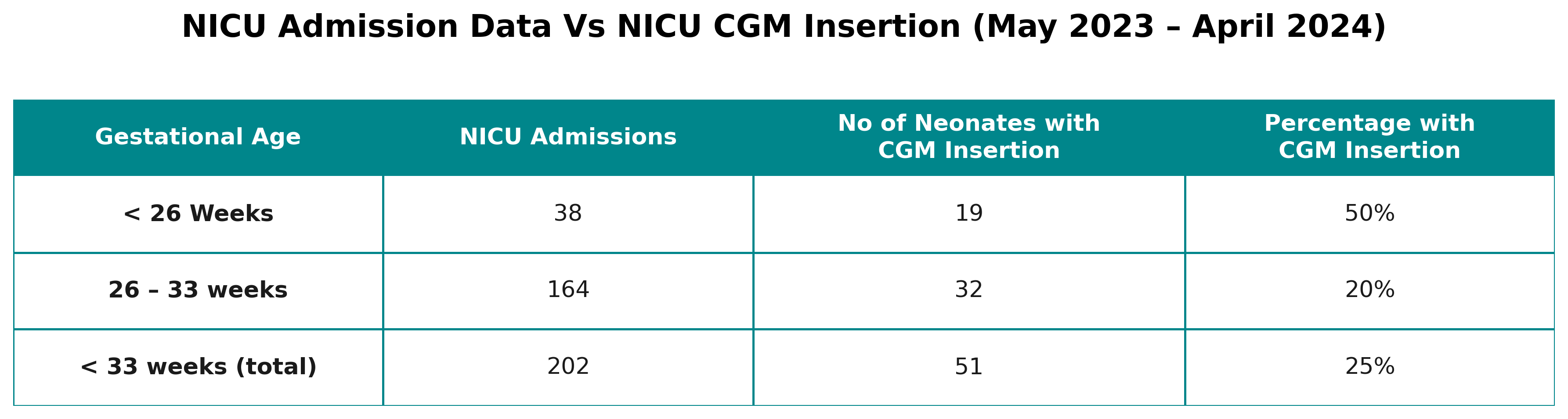
Results: Median Gestational Age (GA) of CGM recipients (at insertion) has fallen from 28+4 weeks in NIRTURE, 27+7 weeks in REACT, to 26+0(range 22+6 – 31+3) weeks in our unit. Median birthweight decreased from 1000g in NIRTURE to 730g(range 455g-1640g) in our unit. 58 neonates received CGM sensors, 51 (88%) were <33 weeks GA representing 25% of neonates (<33 weeks GA) admitted to the unit. 19 sensors were inserted in neonates <26 weeks GA and 32 in neonates 26-33 weeks GA representing 50% and 20% of neonates of each GA cohort admitted to NICU. CGM was inserted at median 26+5 weeks GA. Remaining 7 neonates were term. 98% were very-low-birth weight. First sensors were inserted at median of 3 days of age (interquartile range 2-6) with neonates monitored for median of 7 days (range 1-24). Overall, 79 sensors were used with most neonates having 1 sensor (range 1-4). No adverse events were reported.
Conclusion: CGM was feasible in preterm neonates without adverse events; further research into clinical impact and long-term outcomes is needed.
(Table 1)