Background: Invasive aspergillosis (IA) remains a life-threatening infection in children, but contemporary pediatric prognostic data are limited. We evaluated 90-day mortality and diagnosis-time factors associated with death in an 11-year pediatric IA cohort.
Methods: We retrospectively studied children aged 18 years or younger with IA at a tertiary referral center in southern Thailand from 2015 through 2025. The 2020 EORTC/MSGERC framework was used as the primary classification reference, with investigator adjudication for eight critically ill children without an EORTC/MSGERC host factor. The primary outcome was 90-day all-cause mortality. Diagnosis-time factors were evaluated in an exploratory Cox model. Proportional-hazards assumptions were assessed, with time-varying effects modeled when indicated. Sensitivity analyses addressed case certainty, exclusion of children without an EORTC/MSGERC host factor, alternative mortality horizons, and ridge penalization.
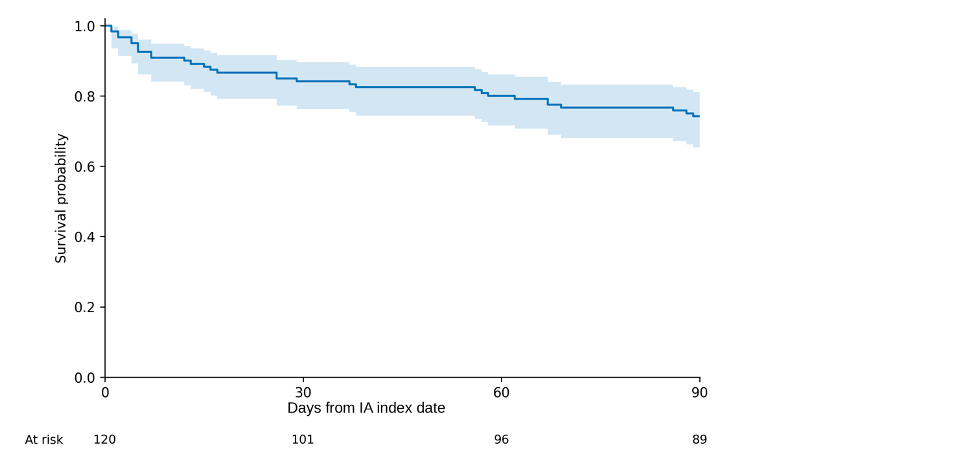
Results: Among 120 children, 3 (2.5%) had study-level proven, 84 (70.0%) probable, and 33 (27.5%) possible IA. Within 90 days, 31 children (25.8%) died, and 47 (39.2%) died within one year; IA was a primary or major contributing cause in 9 of the 31 deaths within 90 days (Figure 1). Hematopoietic stem cell transplantation (HSCT; adjusted hazard ratio [aHR] 5.36, 95% confidence interval [CI] 2.16–13.32), recent pulse methylprednisolone (aHR 3.57, 1.32–9.65), mechanical ventilation (aHR 2.37, 1.08–5.20), and each 1-g/dL decrease in serum albumin (average 0–90-day aHR 2.75, 1.35–5.61) were associated with 90-day mortality. The albumin association was strongest early after IA recognition and attenuated over time. The direction of all four associations was preserved in sensitivity analyses restricted to study-level proven/probable IA and after exclusion of the eight children without an EORTC/MSGERC host factor, although the mechanical-ventilation association attenuated in the proven/probable analysis.
Conclusions: Pediatric IA carried substantial early mortality, with diagnosis-time associations reflecting both host vulnerability and acute illness severity. Recent pulse methylprednisolone and the time-dependent association of lower serum albumin were notable observations in this pediatric cohort. These exploratory, clinically recognizable features may support early risk awareness but require validation in larger multicenter pediatric cohorts.