Background: Medical procedures frequently induce anxiety and distress in pediatric patients. During otomicroscopy and ear suctioning, the high-intensity noise generated by suction devices—often exceeding 100–118 dB—serves as a primary stressor. This prospective randomized controlled trial evaluated whether patient-selected musical distraction, delivered via bone-conduction headphones, reduces physiological stress and perceived pain/distress in children undergoing pediatric ear suction.
Methods: A total of 59 pediatric patients (aged 3–17 years) undergoing outpatient ear suctioning were randomized into either a Music Group (n=28), receiving patient-selected music via bone-conduction headphones during the procedure, or a Control Group (n=31), receiving standard care without auditory distraction. The primary outcome was the change in heart rate (ΔHR) measured via pulse oximetry. Secondary outcomes included pain and procedural distress assessed immediately post-procedure by the child and a parent using the Wong-Baker FACES® Pain Rating Scale, and by clinical staff using the Children’s Emotional Manifestation Scale (CEMS). Continuous data (e.g., ΔHR) were compared using an independent samples t-test, while ordinal pain scores were analyzed using the Mann-Whitney U test. Patient satisfaction was evaluated post-procedure.
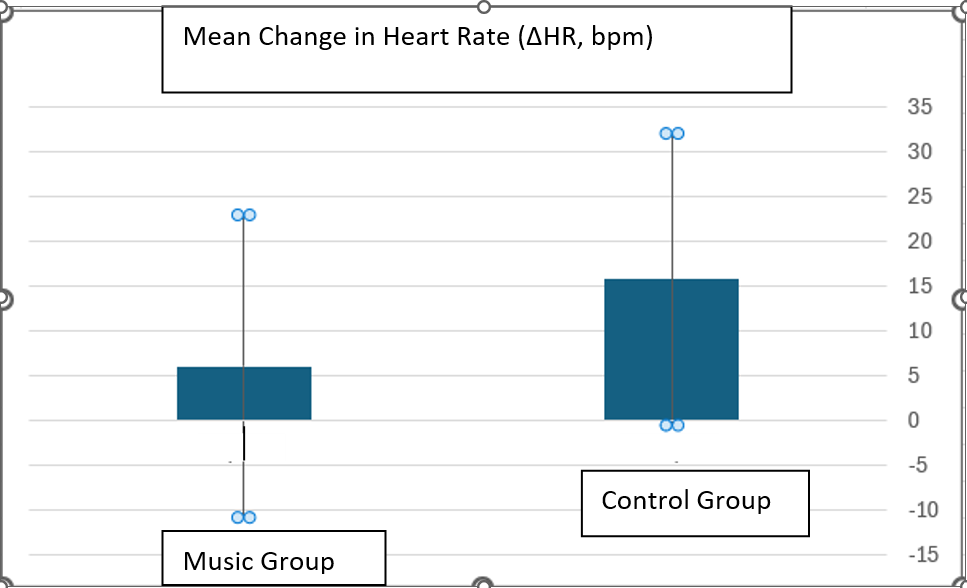
Results: Physiological stress was significantly attenuated in the Music Group compared to controls, with a smaller mean increase in heart rate (6.1 bpm vs. 15.8 bpm, p=0.029) (Figure 1). Clinical staff assessed significantly lower procedural pain and distress in the Music Group compared to the Control Group (median score 1.0 vs. 2.0, p=0.038). However, self-reported pain scores by children (p=0.95) and proxy-reported scores by parents (p=0.58) showed no statistically significant differences between groups. The intervention demonstrated exceptional clinical acceptability, with 83% of children in the Music Group expressing a desire to use bone-conduction music in future procedures.
Conclusions: Musical distraction delivered via bone-conduction headphones is a safe, simple, and highly acceptable non-pharmacological intervention that effectively reduces physiological arousal (as measured by ΔHR) and clinician-observed distress during pediatric ear suctioning. While self-reported pain scores remained low across both cohorts, the significant reduction in objective stress markers and high patient approval support integrating bone-conduction auditory distraction into routine pediatric otolaryngology practice.