Background: UTI's are common in children. Diagnosis can be challenging. Guidelines have been provided by the National Institute of Excellence according to evidence however compliance can be substandard. The previous re-audit in October to December 2018 according to NICE guidelines in 14 patients looking at dipstick results found 70% leukocyte positive, and 50% nitrite positive, bacteriuria in 92.3%, 7.7% pyuria, 78.6% received correct treatment according to dipstick, 50% had USS in acute illness, 57.1% had local follow up, 42.9% had prophylactic antibiotics, with resistance 50% in cephalexin, 33.3% in co-amoxiclav, 50% in amoxicillin, 44.4% in trimethoprim and 0% in nitrofurantoin.
Methods: Setting compliance benchmark of 90% according to the "Urinary tract infection in under 16s: diagnosis and management" NG224 guideline, Diagnosis, investigation, treatment, referral and follow-up in 100 patients presenting at paediatric A&E and Rainbow Ward at Wigan Hospital was audited over a period of 05/02/25 to 04/06/2025. Data was then analysed and interpreted. Seven Criteria categories were used.
Results: Overall compliance was 76%. The areas requiring attention were sampling of urine, interpreting dipstick results and antibiotic use. Signs and symptoms were however well recognised.
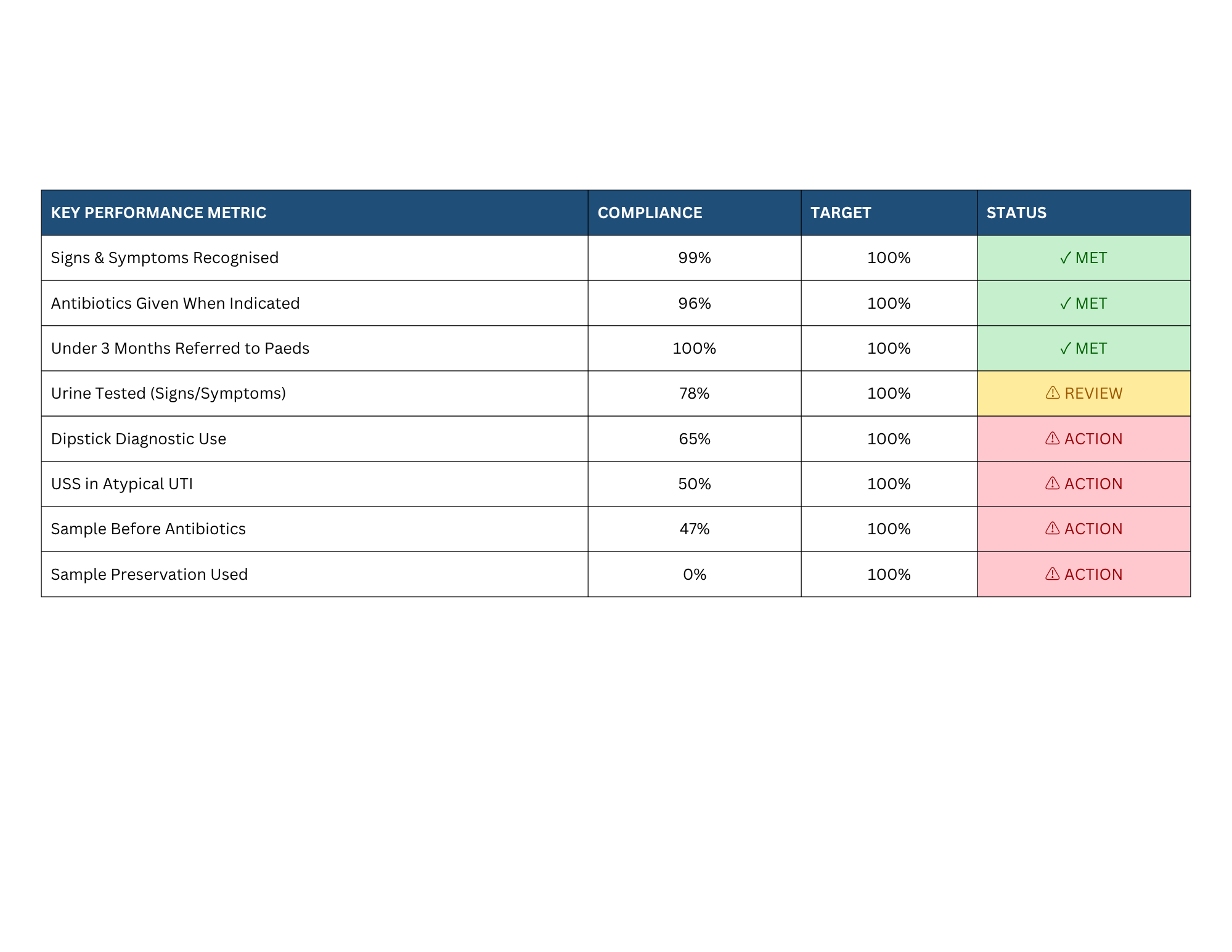
Antibiotic prescription when they should be given was 96%. All children under 3 months were referred to a paediatrician. Testing of urine was only 78%. Appropriate interpretation of urine dipstick according to NICE guidelines was met with 65% compliance. Ultrasonography in atypical UTI in the acute phase compliance was only 50%. DMSA was only done in 50% of cases where indicated. Collection of a sample prior to antibiotic administration was only in 47%. 0% used sample preservation methods. Criteria was met in 4 out of 7 categories (≥90% benchmark), one criterion required review (70-89% compliance), and 2 out of 7 required action (<70% compliance) (Table 1).
Conclusion: A drop in adherence to dipstick interpretation from the previous re-audit could be the potential driving factor behind nitrofurantoin being replaced by cephalexin as the local empirical antibiotic of choice, although sample sizes differed widely between the previous and current re-audit.
Sampling collection methodology to obtain clean catch in children could be reviewed by NICE in favour of other techniques used internationally which have lower false negative results. Preservation with boric acid of samples should be emphasised and education given. Education on how to interpret results may also potentially lessen antimicrobial resistance. Paediatric UTI algorithm flow-chart for the emergency department and ward flow chart could reinforce NICE compliance and local trust policy to diagnosis, management and imaging.