Background: Congenital cytomegalovirus (cCMV) is the leading non-genetic cause of sensorineural hearing loss and an important cause of neurodevelopmental impairment. Early diagnosis of cCMV, preferably within the first 21 days of life, allows for timely treatment. Many neonatal services operate targeted screening based on clinical risk factors, but the diagnostic yield of these triggers is rarely evaluated systematically.
Methods: We conducted a retrospective observational cohort study of all neonates who underwent targeted urine CMV PCR testing in a tertiary maternity hospital neonatal service over a 12-month period (Jan 2025 to Dec 2025). A structured tool captured maternal and antenatal factors, testing triggers, age at sampling, PCR results, clinical workup and management.
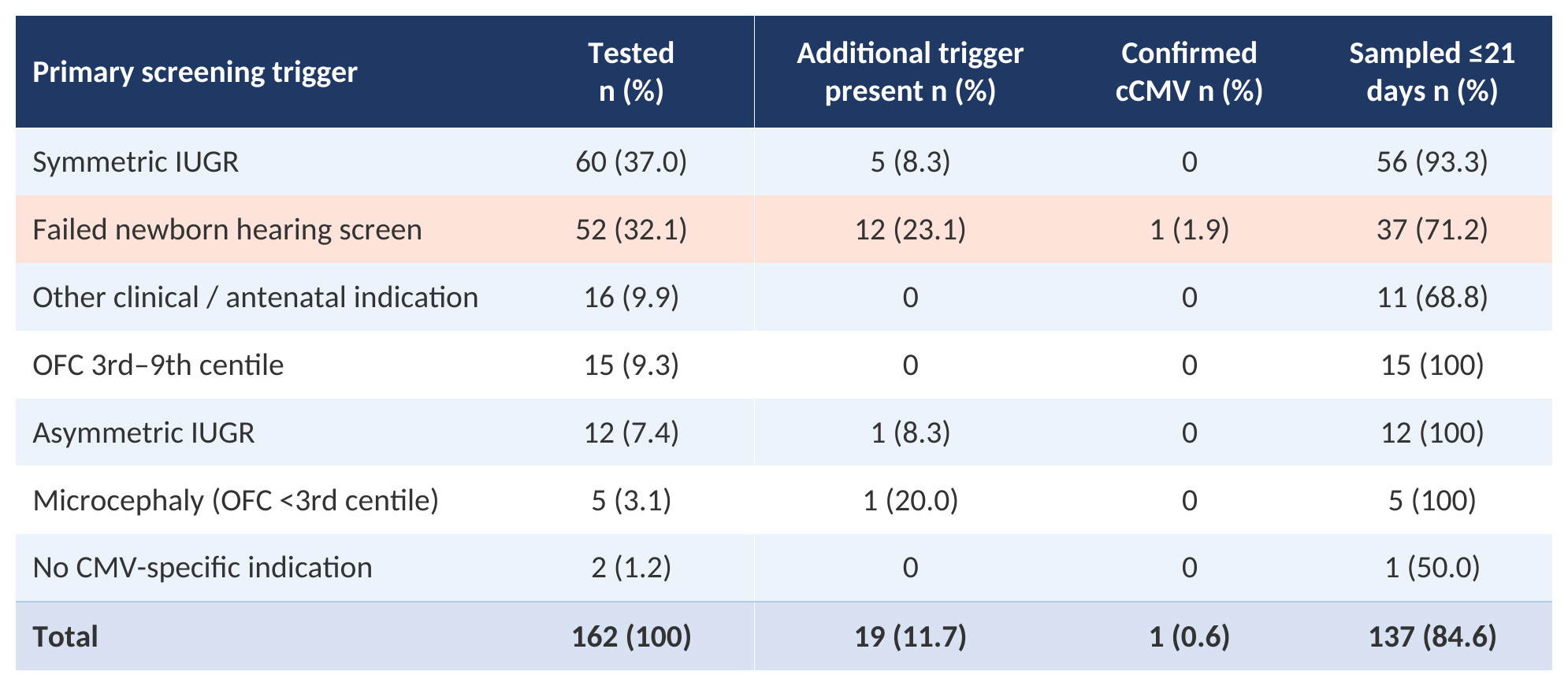
Results: A total of 162 neonates were tested. Mean gestation age was 37.9 weeks (24+5-41+1), birthweight below 3rd centile in 46 infants and between 3rd-10th centile in 27 infants. The diagnostic yield by primary screening triggers (Table 1) were symmetric growth restriction (≤9th centile) (60 infants, 37.0%), a failed newborn hearing screen (52, 32.1%), head circumference between 3rd- ≤9th centile (15, 9.3%), asymmetric growth restriction (12, 7.4%) and other clinical indications (16, 9.9%). CMV DNA was detected in 3 infants (1.9%): one result was a false positive on repeat testing, and one extremely preterm infant was classified as postnatally acquired. One infant, tested after a failed hearing screen, had confirmed congenital CMV, giving a confirmed yield of 0.6% overall and 1.9% within the failed hearing screen group. This infant was asymptomatic on full evaluation and antiviral therapy was appropriately withheld. No confirmed case arose from the 92 infants tested for growth restriction or head circumference ≤9th centile, in whom a placental cause was likely. Overall, 137 of 162 samples (84.6%) were collected within 21 days of life (median 49 days, range 22 to 111) and 61.5% in preterm infants compared with 91.9% in term infants were collected in this time period. Fifteen delayed tests were in preterm infants, including 9 who remained inpatients throughout the window. Of the 10 delayed term tests, 6 followed late referral after a failed hearing screen and 4 were prompted by postnatal concerns, faltering growth in three and facial palsy in one.
Conclusions: Targeted urine CMV PCR screening produced a low confirmed yield concentrated entirely in the failed hearing screen pathway, while growth-based triggers generated a high volume of negative tests. One in six samples were delayed. We plan to implement improved pathways for hearing screen referral, reducing our criteria for screening to head size<3rd centile and avoiding screening neonates with asymmetrical IUGR. A particular focus will be on the preterm infants who are most often missed.