Background: A digital induction handbook was created in December 2024 for resident doctors rotating through the General Paediatrics ward at St Mary’s Hospital. This handbook contains information about day-to-day shifts (General Paediatrics, Haematology, A&E and Infectious Diseases), on-call duties, annual leave, study leave, and important contacts. By December 2025, changing local protocols had made sections outdated or incomplete. This quality improvement project aimed to improve handbook accuracy and accessibility, as well as doctors’ confidence and continuity between shifts.
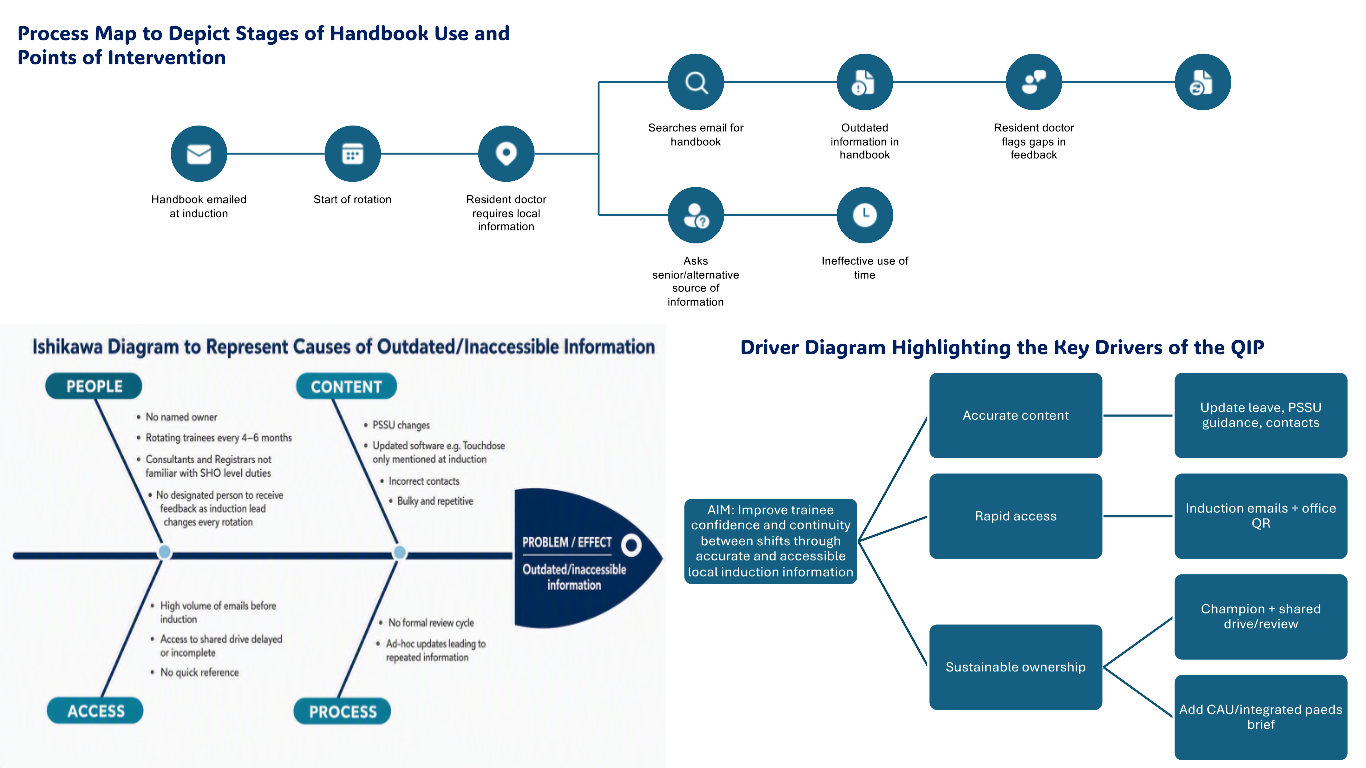
Methods: A baseline survey (n=5) evaluated handbook use, usefulness, navigation and improvement priorities. Process mapping, fishbone analysis of people, process, content and access, and a driver diagram informed change selection. Using PDSA methodology, cycle 1 updated leave guidance, contacts, Paediatric Short Stay Unit practice, scan vetting, TouchDose prescribing and ward flow information. Cycle 2 introduced the handbook at induction, included links in all initial emails, and displayed quick-reference posters with a QR code to access the handbook in the office. A repeat survey (n=3) assessed access, usability, confidence, continuity between shifts and sustainability.
(Figure 1)
Results: At baseline, 2/5 trainees (40%) rated the handbook very useful, 2/5 (40%) somewhat useful, and 1/5 (20%) had never used it. One used it weekly, two monthly, and two never; 3/4 (75%) who answered the navigation question described information as easy or very easy to find. Free-text responses identified outdated leave instructions, unclear rota contacts and changed Paediatric Short Stay Unit processes; 2/5 (40%) preferred a shorter handbook with appendices and 1/5 (20%) a quick-reference guide. All follow-up respondents had used the updated handbook: 2/3 accessed it through an emailed link and 1/3 through a saved copy. Ease-of-use scores were 10, 10, and 8 out of 10; all respondents answered the retrieval-time question and reported finding information within 1–2 minutes. All 3/3 (100%) answered yes to improved day-to-day confidence and improved continuity between shifts. Two of three preferred four-monthly updates and 2/3 supported a designated Handbook Champion; the third answered maybe. Remaining priorities included a Children's Assessment Unit/integrated-pediatrics brief, updated contacts, and annual review with ad hoc updates.
Conclusions: SHO-led handbook revision was associated with favourable self-reported usability, confidence and continuity between shifts. Small, unpaired convenience samples, incomplete responses and subjective outcomes limit causal inference; QR-code uptake was not demonstrated. The next cycle will add the assessment-unit brief, refresh contacts, and store the handbook on the departmental shared drive for consistent access. From December 2026, a rotating Handbook Champion will coordinate four-monthly contact checks, annual formal review and ad hoc updates, supporting a low-cost, transferable sustainability model.