Background: Menstrual irregularity is common in the adolescent period due to hypothalamic pituitary immaturity. However, irregular menstruation with chronic anovulation may be a harbinger of polycystic ovarian syndrome (PCOS). The diagnosis of PCOS/PMOS is particularly challenging in the adolescent period due to the overlap with physiological phenomenon and distinguishing ovulatory and anovulatory cycles may help identify adolescents at risk of chronic anovulation.
Methods: 977 schoolgirls (10-18 years) studying in private schools in Delhi, North India, were evaluated and those with overt hypothyroidism, chronic disease/medication, underweight, or unclear/incomplete menstrual history were excluded [1]. Details of menstrual history were elicited from the students using a structured interview. Menstrual irregularity was defined as per consensus guidelines according to the post-menstrual age [2]. General physical examination included detailed anthropometric data, blood pressure, acne and hirsutism on the face. Blood samples were collected after an overnight fasting irrespective of the menstrual phase and each participant was asked to report the date of start of their last menstrual period and number of days after the onset were calculated to classify the phase of the menstrual cycle. Cycle days 1 to 7 were classified as the ‘early follicular’ phase and ‘luteal phase’ was defined as cycle day > 21 with LH< 20 IU/l and FSH <10 IU/L. The luteal phase was further classified as ovulatory based on a serum progesterone level of 1.65 ng/ml or more. For luteal phase, progesterone values < 1.65 ng/ml were defined as anovulatory cycles. Cycles that did not fall into any category were classified as indeterminate phase. The study was approved by the institutional review board [Ethics approval reference number AIIMSA00098/OP-26/07.10.2024]. Subjects were enrolled after obtaining voluntary informed consent from parents and assent from children. Hormonal measurements: gonadotropins (LH, FSH) and DHEAS were measured by Roche e411 automated analyser using electrochemiluminescence method, steroid hormones using LCMS/MS platform [1] and AMH by Access AMH automated assay (Beckman Coulter).
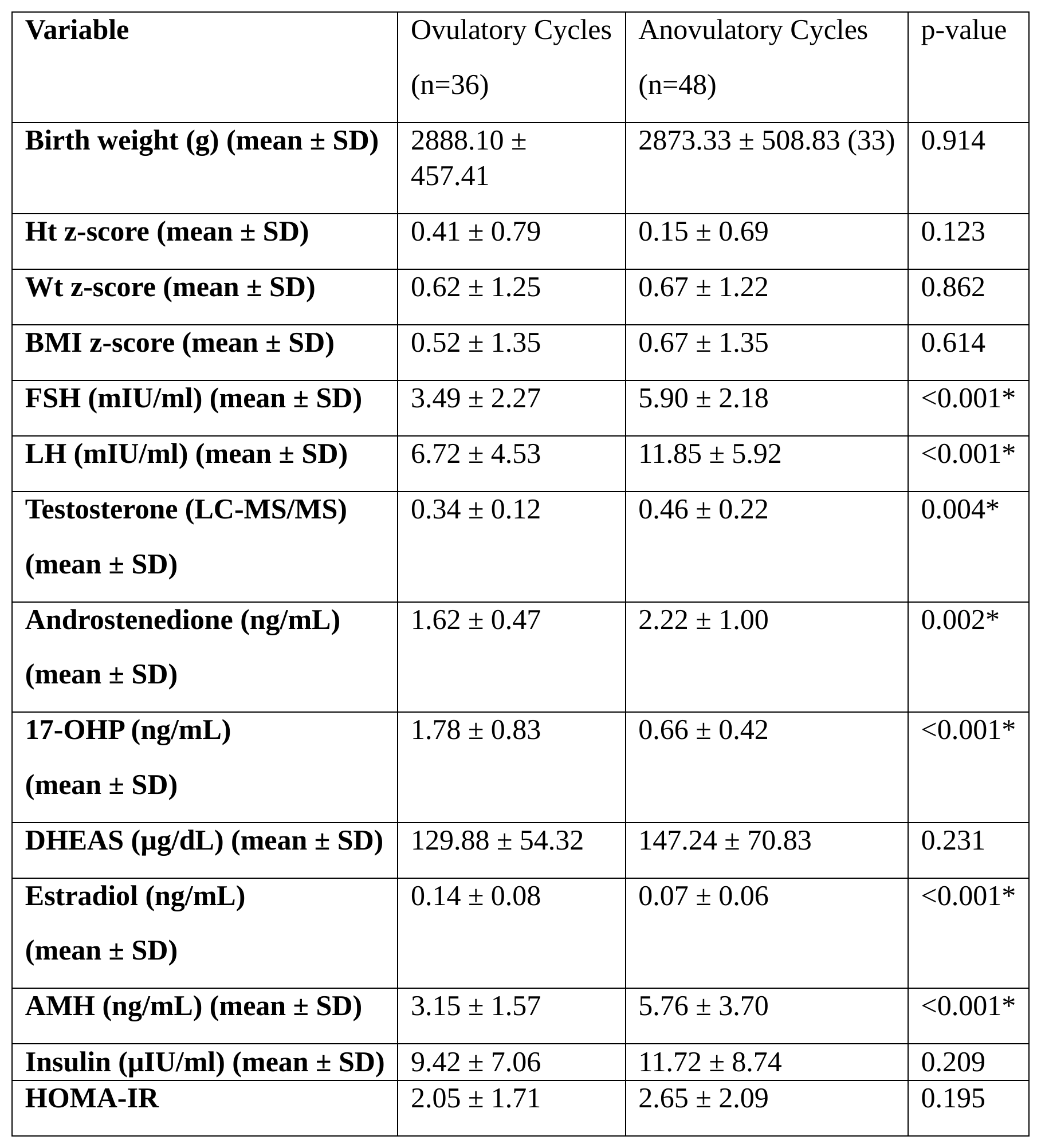
Results: Among girls one year beyond menarche, 152/525 (28.9%) had menstrual irregularity. The menstrual cycles were classified as follicular (n=39), luteal (n=84) and indeterminate (n=29). Of the 84 girls who were in the luteal phase, 48 cycles were anovulatory and 36 were ovulatory. There was no difference in the mean age, post menstrual age, BMI z-score or HOMA-IR between the girls with ovulatory or anovulatory cycles (Table 1). However, the girls with anovulatory cycles had significantly higher levels of LH, FSH, serum testosterone, androstenedione and AMH levels and lower estradiol compared to the girls with ovulatory cycles.
Conclusions: Girls with irregular but ovulatory cycles had significantly lower levels of testosterone and AMH compared to girls with irregular cycles and anovulation. Elevated testosterone and AMH are implicated in chronic anovulation in girls with irregular cycles and may point to possible PCOS/PMOS.