Background: Early maternal breastmilk (MBM) is associated with important benefits for preterm infants, reducing sepsis rates, improving neurodevelopmental outcomes and increasing maternal milk yield. Early colostrum, ideally within 6 hours of birth, is recommended by British Association of Perinatal Medicine (BAPM) guidelines for infants born <34 weeks gestation, with the PERIPrem care bundle setting an 85% target. Timely provision in our local neonatal unit remained challenging, with our preliminary audit showing 16.4% of infants born <34 weeks gestation received MBM within 6 hours of birth. We aimed to increase this to the PeriPREM standard of 85% by April 2026.
Methods: We undertook a two-cycle audit in our local neonatal unit using BadgerNet data for infants born <34 weeks. Baseline data were collected from December 2023-November 2024 and re-audit data from May 2025-April 2026. The primary outcome was receipt of MBM within 6 hours. Secondary outcomes were receipt of MBM within 24 hours and at day 14 and discharge. Outcome-specific eligibility criteria were applied, excluding out-born infants and those who died or were transferred out before the relevant time-point. Between audit cycles, a multidisciplinary programme of interventions was implemented. This included: mobile awareness rounds across maternity and neonatal areas; mandatory induction teaching for neonatal nurses and midwives; routine antenatal counselling on MBM benefits; educational posters; and a standardised maternal expressing review protocol. A neonatal Baby Friendly Initiative working group was established to provide organisational oversight.
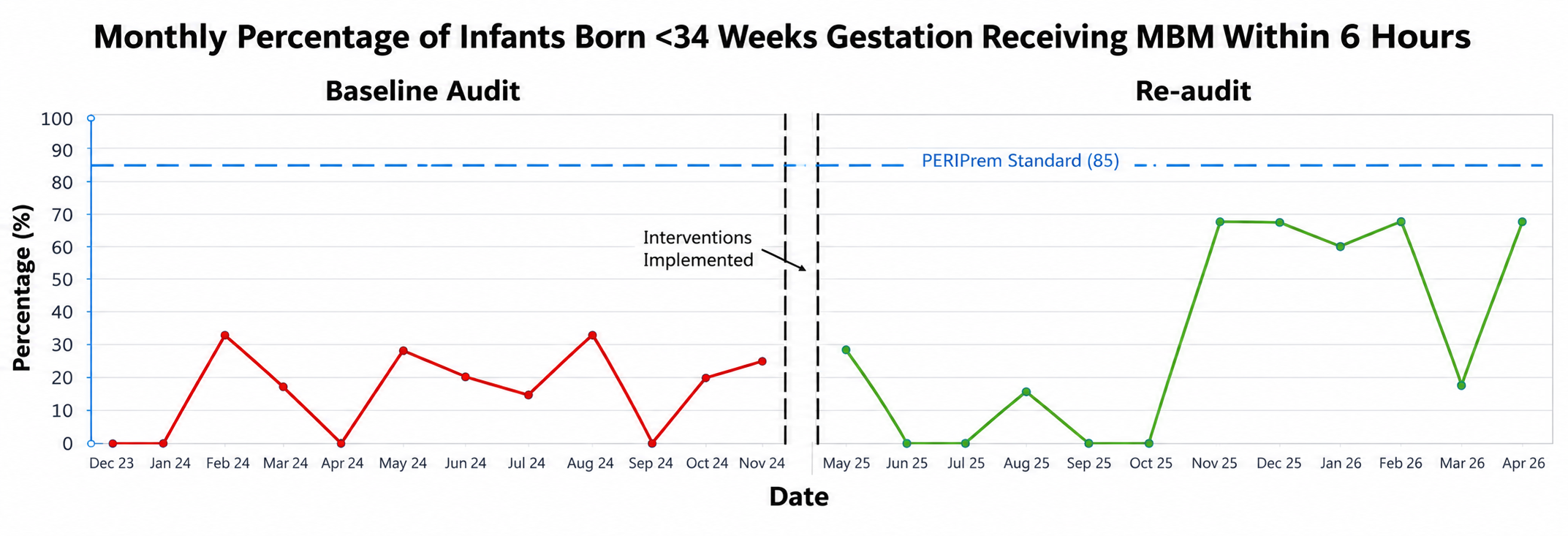
Results: The proportion of infants receiving MBM within 6 hours increased from 16.4% (n=67) to 31.5% (n=54) at re-audit. Monthly data showed an initial plateau, followed by sustained improvement from November 2025 with rates ≥60% in five of the final six months (Figure 1). The re-audit cohort had lower mean gestation (31+2 versus 32+1 weeks) and birthweight (1550g versus 1685g). Improvement was also seen in secondary outcome measures, with the proportion of infants receiving MBM within 24 hours increasing from 44.6% (n=65) to 62.5% (n=48). Receipt of any MBM at day 14 and discharge increased from 69% and 41% (n=58) respectively to 85% and 68% (n=41).
Conclusion: A multi-faceted, multi-disciplinary approach was associated with sustained improvements in MBM provision across multiple time-points, suggesting targeted interventions can positively influence feeding practices in preterm infants. However, the PERIPrem 6-hour target was not achieved highlighting the need for continued quality improvement efforts. In response, our unit has also updated the standard operating procedure for antenatal colostrum expression in planned preterm deliveries and introduced exception reporting for all infants who do not receive colostrum within 6 hours of birth. These measures aim to identify barriers, facilitate learning, and inform further service development. Continued integration and evaluation of these interventions may help increase early MBM provision and ultimately improve outcomes.