Background: The 2024 BTS/SIGN/NICE Asthma guideline established that children with a history suggestive of asthma should undergo objective testing for asthma. However, access to such testing in primary care has historically been limited. Therefore, London Northwest University Healthcare NHS Trust, together with Imperial NHS Trust, developed an objective testing service at the Ealing Community Diagnostic Centre (CDC). GPs can refer patients aged 5-17 with a history suggestive of asthma. Referrals are then vetted and appointments scheduled. During a one-hour appointment, patients have anthropometry, fractional exhaled nitric oxide (FeNO) testing, spirometry with bronchodilator reversibility (BDR), skin prick testing for aeroallergens, and eosinophil level (if no result is available from the last 12 months). Results are then sent to the patient’s GP with guidance on interpretation. In this review, we have evaluated the outcomes of this novel community diagnostic service.
Methods: We conducted a retrospective review of electronic records for patients aged 5-17 who underwent objective testing at Ealing Community Diagnostic Centre (CDC) between March 2025 and May 2026. Data collected included: referral source and outcomes, waiting times, diagnostic test results and anonymised caregiver feedback.
Results: A total of 1,014 referrals were received (902 GP and 110 hospital referrals). Overall, 757 referrals (74.7%) were accepted and 253 (25.0%) rejected, primarily due to incorrect or incomplete referral forms (116 and 60 referrals, respectively). Median referral-to-triage time was 1 day, with a median referral-to-first appointment offer of 10 days.
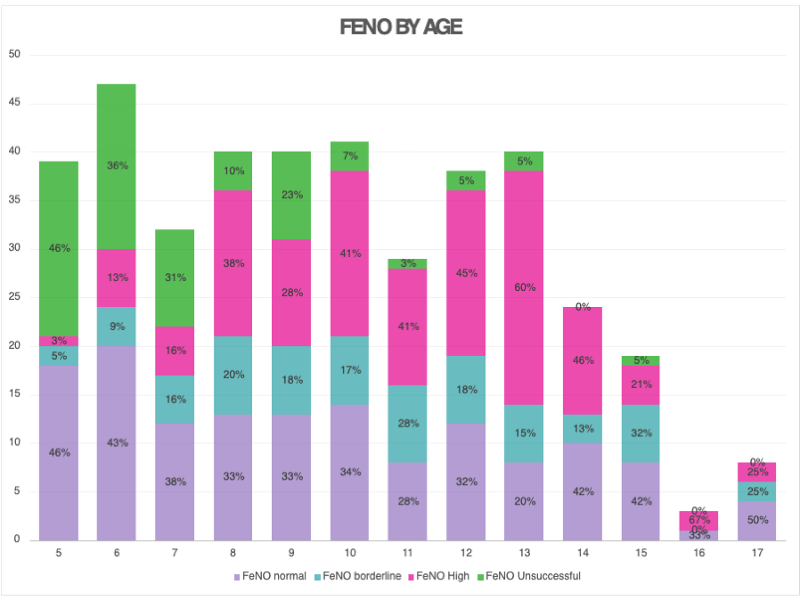
Among accepted referrals, 401 children completed diagnostic testing. Mean age of tested children was 9.7 years. Objective testing identified abnormal findings in a substantial proportion of patients, including positive bronchodilator reversibility in 86 children (21.4%), elevated FeNO in 128 (31.9%), and obstructive spirometry in 51 (12.7%). Allergy testing was frequently positive, with 276 positive skin prick tests (68.8%) and 218 house dust mite sensitisation results (54.4%). Testing success was age dependent. Overall, FeNO testing was unsuccessful in 17% of cases in this dataset, and this was more frequent in younger cohorts. For children aged five, six and seven, FeNO testing was unsuccessful in 46%, 36% and 31% of cases, respectively. By comparison, testing was unsuccessful in only 3.7% of 11–17-year-olds. Similar results were seen in spirometry, being unsuccessful amongst 15.3% of 5 and 6-year-olds, compared to 4.5% of 7 to 17-year-olds. Overall, patient experience of the service was highly favourable, with 94% rating the service as good or very good.
(Figure 1)
Conclusions: A community-based paediatric asthma diagnostic pathway can provide wider access to diagnostics and high levels of patient satisfaction while facilitating objective asthma diagnosis. The service successfully identifies treatable traits such as airway inflammation and allergic sensitisation. Whilst overall feasibility is high, failure rates in FeNO and spirometry testing amongst children under eight years – aligning with previous studies showing that FeNO testing is feasible in only approximately 20% of 5-year-olds – highlight a potential limitation of this diagnostic pathway. Furthermore, improving referral quality may reduce unnecessary rejections and further optimise service efficiency.