Background: Body mass index (BMI) remains the standard screening measure for childhood obesity but provides limited information on adiposity, muscular fitness and cardiometabolic risk. The PESCA (Cardiovascular Health School Program) assessment integrates BMI, bioelectrical impedance analysis (BIA) and handgrip strength, including handgrip strength relative to body weight (HGS/kg), to provide a multidimensional evaluation of cardiovascular health in children and adolescents.
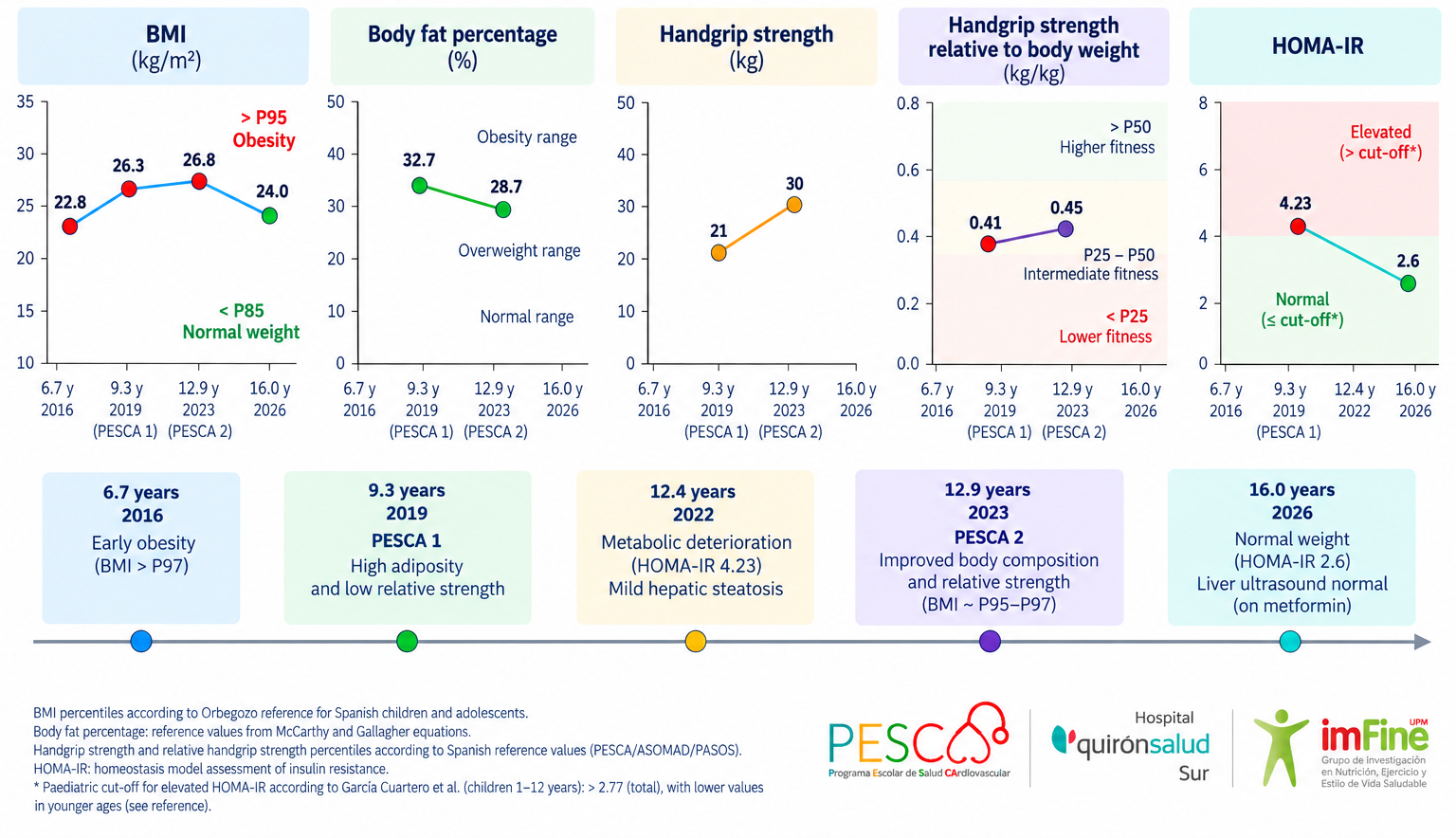
Case Presentation: A boy was followed longitudinally from childhood to age 16 years (Figure 1). At 6 years 7 months (13 December 2016), weight was 32.3 kg, height 119 cm and BMI 22.81 kg/m², already above P97, indicating obesity.
At the first PESCA assessment (20 September 2019; age 9 years 4 months), weight was 51.1 kg, height 140 cm and BMI 26.3 kg/m², markedly above P97. Body fat was 32.7%, clearly within the obesity range for age and sex. Absolute handgrip strength was 21 kg (approximately P90), whereas HGS/kg was 0.41 kg/kg, below P25 for age and sex.
Metabolic deterioration subsequently became evident. In September 2022, HOMA-IR was 4.23 and fasting insulin 19.1 µIU/mL; abdominal ultrasound on 6 October 2022 showed mild diffuse hepatic steatosis.
At the second PESCA assessment (26 April 2023; age 12 years 11 months), weight was 66.4 kg, height 158 cm and BMI 26.8 kg/m². Despite an almost unchanged absolute BMI, its age-adjusted position improved markedly, shifting from well above P97 to approximately the P95–P97 range. Body fat decreased from 32.7% to 28.7%, remaining within the obesity range but approaching its lower threshold for age and sex. Absolute handgrip strength increased to 30 kg, remaining approximately P90, whereas HGS/kg increased to 0.45 kg/kg, between P25 and P50.
At final follow-up in May 2026, aged 16 years, weight was 70.2 kg, height 171 cm and BMI approximately 24.0 kg/m² (<P85), corresponding to normal weight according to the Orbegozo reference. Blood pressure was 117/73 mmHg. HbA1c was 5.6%, fasting insulin 11.0 µIU/mL and HOMA-IR 2.6, with a favourable lipid profile and normal transaminases. Metformin was maintained. A follow-up abdominal ultrasound performed in May 2026 was reported as normal.
Learning Points: This case illustrates that paediatric obesity and its evolution cannot be adequately characterized by absolute BMI alone. Between the two PESCA assessments, absolute BMI remained almost unchanged, while age-adjusted BMI position, adiposity and relative muscular strength improved substantially. Absolute handgrip strength remained approximately P90 at both assessments, potentially masking functional vulnerability because absolute strength is strongly influenced by body size. In contrast, HGS/kg shifted from below P25 to the P25–P50 range.
Integrating BMI trajectory, body composition and relative muscular strength may provide a more informative approach to longitudinal cardiometabolic risk assessment, revealing clinically meaningful changes that absolute BMI or absolute muscular strength alone may fail to detect.