Background: In 2022, the American Academy of Pediatrics (AAP) updated its clinical practice guideline for hyperbilirubinemia in newborns ≥35 weeks' gestation, raising phototherapy treatment thresholds relative to the 2004 guideline. We conducted a systematic review and meta-analysis of observational studies of the guideline's effect on treatment intensity, resource use, and safety.
Methods: We searched the Cochrane Library, PubMed, Embase, ResearchGate, and Google Scholar from July 28 to August 3, 2026, for cohort studies comparing bilirubin-related outcomes before and after implementation of the 2022 guideline. Quality-improvement (QI) implementation studies were retained, since guideline uptake in practice is ordinarily mediated by such programs; a sensitivity analysis tested their influence. Risk of bias was assessed using ROBINS-I V2 and certainty of evidence using GRADE. Risk ratios (RR) and mean differences (MD) were pooled using inverse-variance random-effects models (REML).
Results: Of 30 identified cohort studies, 9 were excluded, leaving 21 assessed at domain level. None achieved an overall "Low" rating; 2 were Moderate, 17 Serious and 2 Critical, driven predominantly by uncontrolled confounding: unadjusted calendar-period comparisons without reported baseline characteristics.
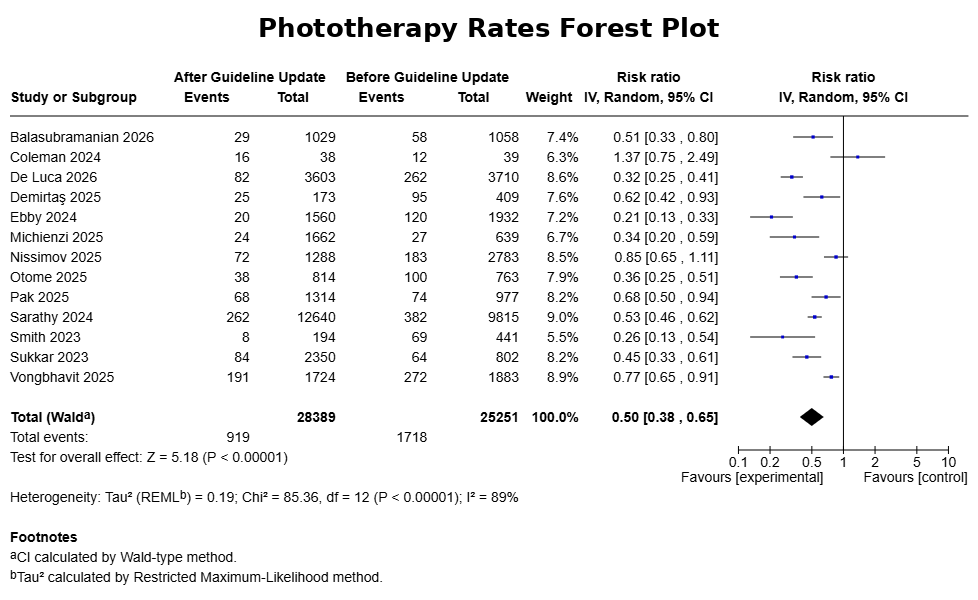
Thirteen studies (53,640 infants) contributed to the phototherapy analysis. Phototherapy incidence fell after implementation (RR 0.50, 95% CI 0.38–0.65; P < 0.00001), or 34 fewer treatments per 1,000 births, though heterogeneity was very high (I² = 89%); estimates were similar in US and international cohorts (RR 0.45, 0.60). Thirteen studies (70,005 infants) contributed to the readmission analysis; jaundice-related readmission was also lower (RR 0.69, 0.54–0.87; P = 0.002; I² = 43%), or 4 fewer per 1,000. Excluding QI studies moved this estimate to no effect (RR 0.81, 0.66–1.00) and removed the heterogeneity entirely (I² = 0%), whereas the same exclusion barely altered phototherapy (RR 0.49, 0.38–0.64; I² = 86%). The international readmission subgroup likewise showed no effect (RR 0.83, 0.55–1.24). No funnel-plot asymmetry was detected when testing for publication bias.
(Figure 1)
Among secondary outcomes, serum bilirubin testing fell substantially (RR 0.57, 0.47–0.69; I² = 94%) and total serum bilirubin at phototherapy initiation rose by 1.93 mg/dL (1.49–2.38), confirming that thresholds shifted in practice. Phototherapy given below the applicable threshold nonetheless became more common among treated infants (RR 1.68, 1.25–2.27), indicating incomplete adherence. Exchange transfusion did not differ (RR 0.94, 0.41–2.15), and no bilirubin-induced neurologic dysfunction occurred in either period (0/7,582 vs. 0/8,190). Length of stay (MD 0.04 days, 0.02–0.07) was marginally longer after implementation, while phototherapy duration (MD −1.24 hours, −4.75 to 2.27) was unchanged. GRADE certainty was very low for every outcome except length of stay (low).
Conclusions: Implementation of the 2022 AAP guideline was associated with roughly halved phototherapy use and reduced bilirubin testing, without evidence of a compensatory rise in readmission, exchange transfusion or neurologic injury. Safety outcomes were too infrequent to exclude harm and adherence to the raised thresholds was incomplete. The readmission benefit was concentrated in QI studies; because guidelines are ordinarily adopted through such programs, we regard these as the more realistic estimate of attainable impact, although QI bundles may carry co-interventions beyond the threshold change. The evidence base is limited by serious-to-critical risk of bias from uncontrolled before-after designs and high heterogeneity. These findings are hypothesis-generating rather than conclusive; standardized, prospective studies are recommended for future analysis.