Background: Children and Young People Seeking Asylum and Refugees who are unaccompanied (CYPSAR-U) are a growing population in the UK with complex healthcare needs. Universal screening demonstrates significant rates of infectious disease, many of which are asymptomatic but readily treatable when identified, supporting its importance. Vaccination histories are frequently incomplete or unavailable making timely catch-up immunisation essential. However, there is limited evidence describing vaccination uptake following specialist assessment. This audit evaluated infectious disease screening outcomes and catch-up vaccination uptake among CYPSAR-U attending a paediatric infectious disease service, compared with Royal College of Paediatrics and Child Health (RCPCH) guidelines.
Methods: A retrospective review was undertaken of CYPSAR-U attending the paediatric infectious disease clinics at Northwick Park Hospital for universal screening between September 2023 and April 2026. Demographic data, clinic attendance, interpreter use and referral information were extracted from electronic health records. Infectious disease screening included tuberculosis (QuantiFERON), blood borne viruses, syphilis, strongyloides, schistosomiasis, sexually transmitted infections and baseline blood investigations. Documentation of catch-up immunisation, including hepatitis B and BCG, was reviewed and compared with UK Health Service Agency guidance on vaccination of individuals with uncertain or incomplete immunisation status.
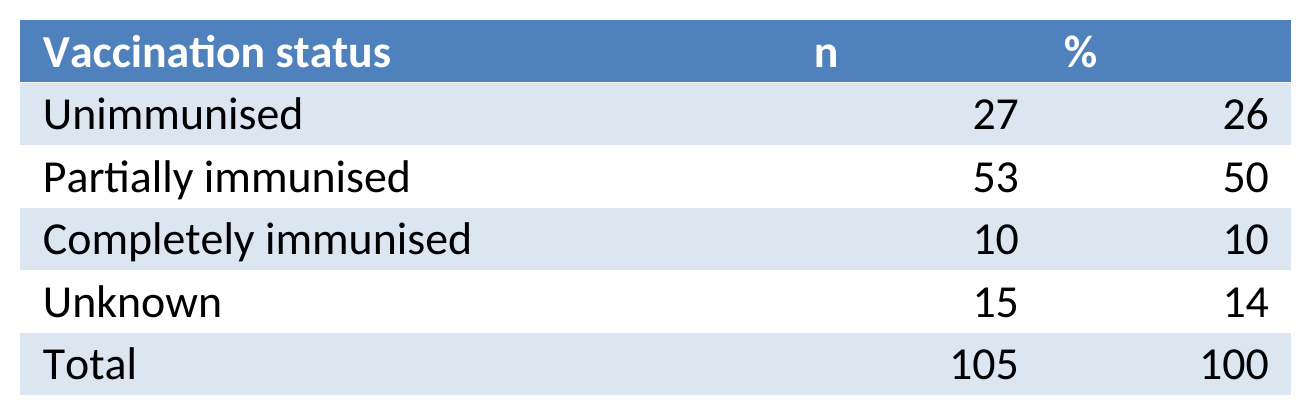
Results: A total of 105 patients were included. Ninety seven percent were male, with a mean age of sixteen years. The most common countries of origin were Sudan (20%), Afghanistan (18%) and Syria (17%). Nineteen percent of children were diagnosed with at least one infectious disease. The most frequent diagnoses were schistosomiasis (50%) and latent tuberculosis (45%). All identified infections were treated. Clinic attendance was poor: over half were not brought to at least one appointment. Only 13% of patients completed all recommended catch-up immunisations. Vaccine uptake was particularly low for hepatitis B and TB (BCG), at 16% and 2%, respectively. MMR had the highest uptake with 46% completing the course (Table 1).
Conclusions: Universal infectious disease screening demonstrated a high diagnostic yield, identifying previously undiagnosed, often asymptomatic, treatable infections in almost 1 in 5 CYPSAR-U, supporting current evidence for universal screening in this high-risk population. However, the overall impact of screening is limited by poor clinic attendance, highlighting the need to better understand and address barriers to engagement with healthcare services in this vulnerable population group. Low catch-up vaccination completion rates despite specialist assessment represent a significant missed opportunity for preventative healthcare. Future service evaluation should explore barriers to vaccine delivery, including current pathways, and assess whether opportunistic vaccinations within specialist services could improve uptake and support complex healthcare needs.