Background: The sensory-rich environment and frequent interactions with unfamiliar healthcare providers in the emergency department (ED) can be overwhelming for children and youth with Autism Spectrum Disorder (ASD) and neurodivergence, thus increasing the risk of behavioral escalation and safety challenges (1). The effectiveness of a de-escalation care pathway on the delivery of efficient emergency care to this population remains unclear (2,3). The objective of this quality improvement (QI) project was to implement a patient-centered de-escalation care pathway and evaluate its impact on pediatric ED (PED) length of stay (LOS) for discharged patients as the primary outcome, in addition to other selected metrics, with a goal of 20% improvement.
Methods: In March 2024, we convened as a multidisciplinary QI collaborative to adopt a standardized, multimodal de-escalation approach for managing agitation/anxiety in our target population. Our care pathway integrated the Emergency Medical Services for Children Pediatric Education and Advocacy Kit agitation guideline, a sensory toolkit, environmental redesigns, and a clinical decision tool. Monthly retrospective chart reviews were conducted to assess the effects of several Plan-Do-Study-Act cycles on process measures including medication choice for behavioral control, multiple medication dosing, time elapsed from ED arrival to lab acquisition, completion rate for full set of vital signs, and mean PED LOS. Patients were identified using ICD-10 codes for neurodevelopmental diagnoses. The program Minitab© was used to aid in analysis and creation of Statistical Process Control charts.
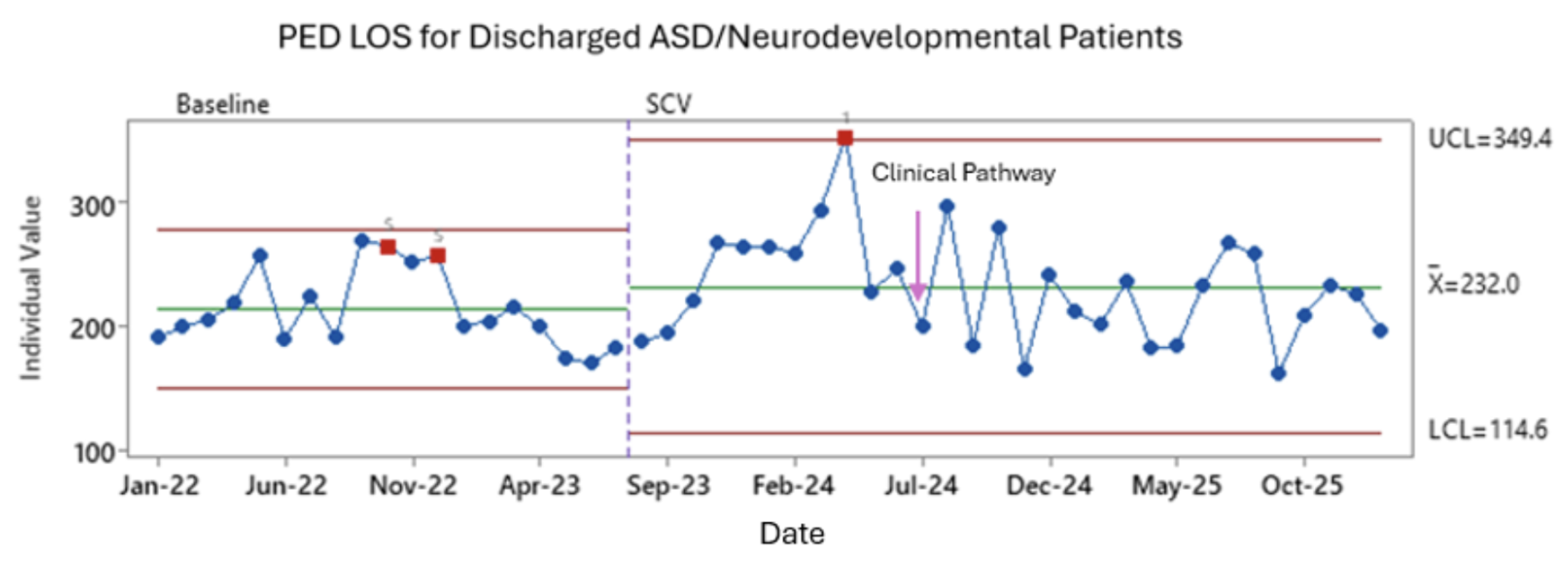
Results: A total of 2268 eligible patients were included. There was a reduction in benzodiazepine use for anxiolysis by 28.3% (60% to 43%) as well as in the mean percent of patients requiring greater than two medication doses by 40% (11.9% to 7.1%), meeting our goal of 20%. The mean completion rate for the full set of vital signs increased by 19% (62.1% to 72.9%), close to our goal. The average time elapsed to lab acquisition decreased by 11.8% (112.3 minutes to 99 minutes). The mean PED LOS for discharged patients increased by 7.5% (216 minutes to 232 minutes) (Figure 1). However, the effects of PED patient volume and other contributory factors were not assessed for determining adjusted mean LOS.
Conclusions: Standardized guidelines, sensory-friendly strategies, and family engagement have been shown to mitigate risks, improve patient safety, and patient experience for pediatric patients with ASD. Building on these principles, this QI initiative also sought to improve operational efficiency in the PED. Although the goal for monthly mean LOS was not achieved, implementing a de-escalation care pathway ensured judicious medication administration and contributed to a favorable impact on mean clinical task completion rates.