Background: Adolescent idiopathic scoliosis (AIS) may negatively affect postural control, balance, body image, and psychosocial well-being during adolescence, in addition to causing structural changes. Exercise-based conservative treatment approaches, such as the Schroth method, aim to promote three-dimensional (3D) postural correction, reduce the progression of deformity, and improve functional outcomes. Meanwhile, advances in rehabilitation technologies have enabled the use of interactive and technology-assisted exercise approaches with the potential to enhance balance, engagement, motivation, and treatment adherence. However, evidence directly comparing technology-assisted rehabilitation with established scoliosis-specific exercise approaches remains limited. The aim of this study was to compare the effects of Schroth exercises and technology-assisted rehabilitation on trunk rotation, Cobb angle, body image, static balance, and treatment satisfaction in individuals with AIS.
Methods: Thirty children diagnosed with AIS were included in the study (age;12,87 ± 1,11). Participants were allocated to either the Schroth exercise group (Group 1, n=15) or the technology-assisted rehabilitation group (Group 2, n=15). Both exercise programs were implemented three days per week for 12 weeks. The angle of trunk rotation (ATR) and Cobb angle were used for the clinical and radiographic assessment of scoliosis. Body image perception was assessed using the Walter Reed Visual Assessment Scale (WRVAS), while static balance performance was evaluated using the Flamingo Balance Test. In addition, participants’ satisfaction with the intervention was assessed using a 10-point Likert-type scale.
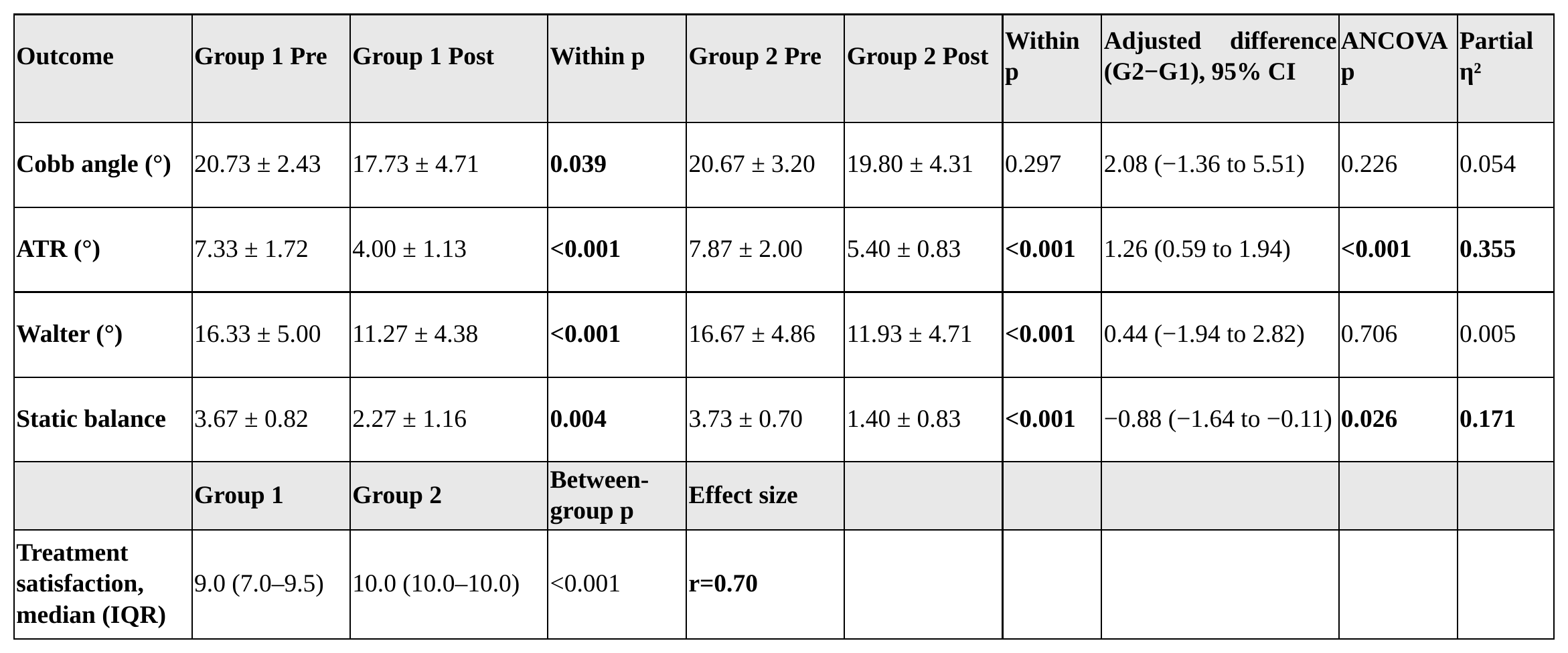
Results: A total of 30 participants were included in the analysis, with 15 participants in each group. The groups were comparable at baseline in terms of age, Cobb angle, angle of trunk rotation (ATR), Walter measurement, and static balance (all p>0.05) (Table 1). Group 1 demonstrated a significant reduction in Cobb angle (p=0.039), whereas the change in Group 2 was not statistically significant (p=0.297). However, baseline-adjusted between-group analysis did not demonstrate a significant difference in post-intervention Cobb angle. ATR decreased significantly in both Group 1 (p<0.001) and Group 2 (p<0.001). Importantly, ANCOVA demonstrated a significant between-group difference after adjustment for baseline ATR, favoring Group 1. Walter measurements also decreased significantly in both groups, with no significant difference between groups after baseline adjustment (p=0.706). Static balance scores improved significantly in both Group 1 (p<0.001). Baseline-adjusted analysis indicated a significantly greater improvement in Group 2. Treatment satisfaction was high in both groups; however, participants in Group 2 reported significantly greater satisfaction than those in Group 1.
Conclusions: Three-dimensional Schroth exercises and technology-assisted rehabilitation have emerged as effective approaches that offer different clinical benefits in the conservative management of adolescent idiopathic scoliosis. The findings indicate that Schroth exercises may be particularly effective in controlling scoliosis-specific deformities, whereas technology-assisted rehabilitation shows considerable potential for improving balance and the overall treatment experience. In particular, the high level of treatment satisfaction observed with the technology-assisted approach may be noteworthy in supporting adherence to and sustainability of long-term rehabilitation programs among adolescents. These findings suggest that technology-assisted interventions may be considered not merely as an alternative to conventional scoliosis-specific exercises, but also as a complementary rehabilitation option targeting different therapeutic goals.