Background: Immune thrombocytopenia (ITP) is the most common cause of acquired thrombocytopenia in children. It is typically an immune-mediated, self-limiting disorder characterized by isolated thrombocytopenia, with clinical manifestations ranging from asymptomatic thrombocytopenia to mucocutaneous and, rarely, severe bleeding. Although pediatric ITP has been extensively studied internationally, data from the Middle East remain limited, particularly from Oman. Understanding local disease characteristics, treatment patterns, and outcomes may help guide evidence-based management and future national strategies.
Objectives: To describe the demographic characteristics, clinical presentation, laboratory findings, management patterns, and outcomes of pediatric patients diagnosed with ITP at a tertiary care center in Oman.
Methods: We conducted a retrospective descriptive cohort study at University Medical City, Oman. Pediatric patients diagnosed with ITP between January 2006 and December 2023 were identified through the electronic medical record system. Demographic characteristics, presenting symptoms, laboratory findings, preceding infections, treatment modalities, platelet recovery, complications, and mortality were collected. Continuous variables were summarized using means, medians, and ranges, while categorical variables were presented as frequencies and percentages.
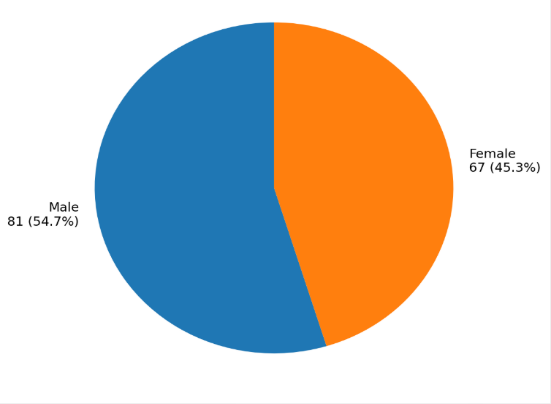
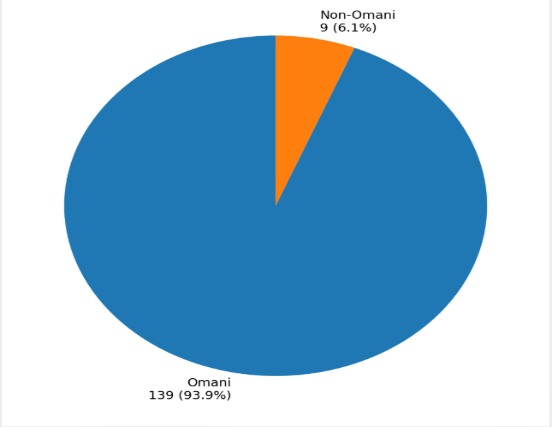
Results: A total of 148 pediatric patients were included. Most patients were younger than 10 years, with the highest proportion belonging to the 1–5-year age group (Figure 3). There was a slight male predominance, with males accounting for 54.7% of the cohort (Figures 1 and 2). Mucocutaneous bleeding was the predominant clinical presentation, with petechiae and purpura reported in 87.2% of patients. A preceding viral infection was documented in 49.2% of patients with available information. Laboratory evaluation demonstrated predominantly isolated thrombocytopenia, with a mean platelet count of 18.7 × 10⁹/L at presentation. Nearly half of the patients (48.0%) were managed with observation alone, whereas 52.0% received pharmacological treatment. Among treated patients, 33 received corticosteroids alone, 22 received intravenous immunoglobulin (IVIG) alone, and 49 received combination therapy with corticosteroids and IVIG. Overall, platelet recovery was achieved in 81.1% of patients, with the majority recovering within six months. Delayed recovery beyond 12 months was observed in 10.8% of patients (Tables 1 and 2). Severe complications were uncommon, and no mortality was reported.
Conclusion: Pediatric ITP in this Omani cohort predominantly affected young children and commonly presented with mucocutaneous bleeding in the setting of severe thrombocytopenia. Despite markedly low platelet counts, nearly half of patients were successfully managed with observation alone, and overall outcomes were favorable. The high rate of platelet recovery and low rate of complications support the generally self-limiting nature of childhood ITP. This study provides important real-world data on pediatric ITP in Oman and highlights local management patterns and outcomes that are broadly consistent with contemporary international practice. These findings may serve as a foundation for future multicenter studies and contribute to the development of context-specific national management strategies.