Background: Children with cerebral palsy (CP) may experience difficulties in both manual abilities and sensory processing, which can influence their performance and participation in daily activities. Manual ability varies considerably among children with CP, and greater limitations in manual performance may coexist with differences in sensory processing. However, the distribution of sensory processing patterns according to levels of manual ability has not been sufficiently explored. Understanding this relationship may provide additional information for occupational therapy assessment and intervention planning. This study aimed to examine whether sensory processing patterns differ according to Manual Ability Classification System (MACS) levels in children with CP.
Methods: This cross-sectional study included 55 children with CP aged 6–10 years. Manual ability was classified using the MACS, and sensory processing patterns were assessed using the Dunn Sensory Profile Caregiver Questionnaire. Data were analyzed using SPSS 29.0 (Statistical Package for the Social Sciences). The distributions of sensory processing categories across MACS levels were examined using Pearson's chi-square tests, and Cramer's V was used to estimate the strength of associations.
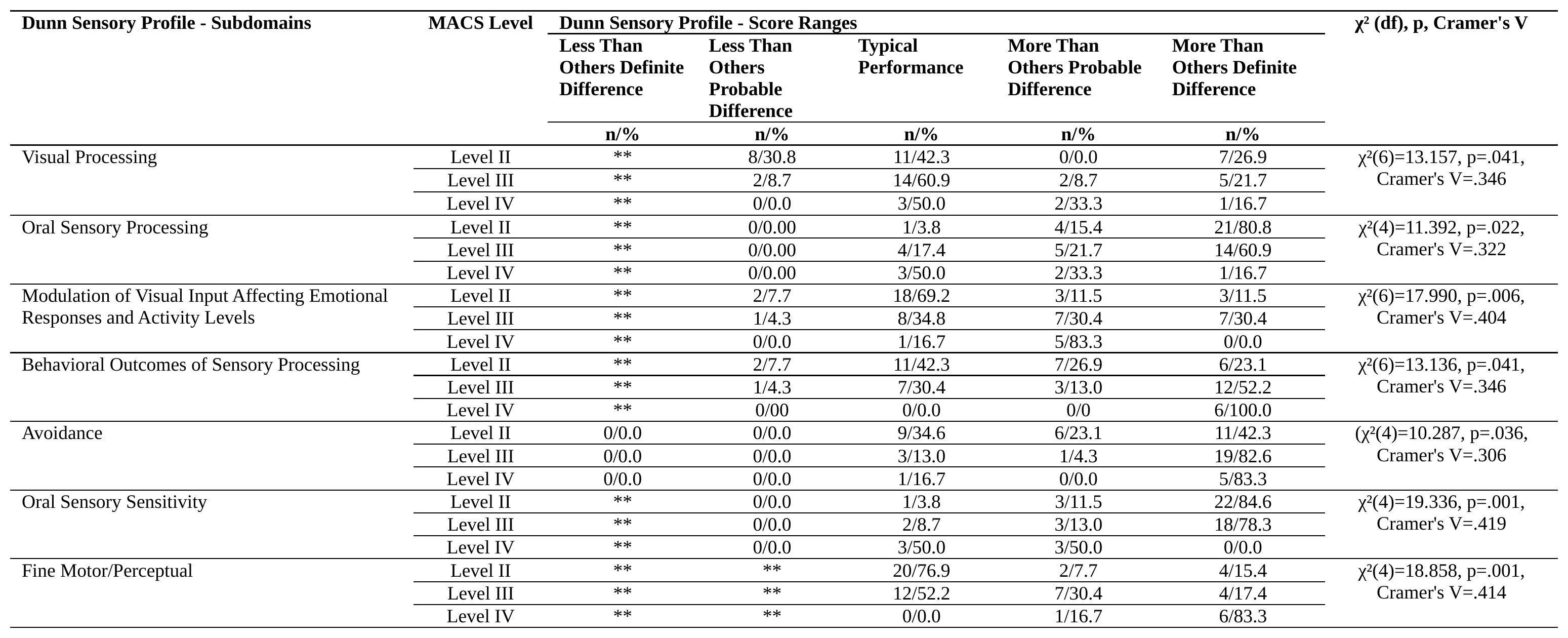
Results: The mean age of the participants was 8.15±1.47 years; 38.18% were female and 61.82% were male. Regarding manual ability, 26 participants (47.27%) were at MACS Level II, 23 (41.82%) at Level III, and 6 (10.91%) at Level IV. Within the Dunn Sensory Profile, except for items defining visual processing and thresholds for response in the main sections and the poor registration and fine motor/perceptual factor domains, more than 50% of the participants performed outside the typical performance range in all areas. Additionally, for low registration quadrant and the emotional reactivity factor domain, all participants were observed to perform outside the typical performance range. Significant differences in the distribution of Dunn Sensory Profile categories were observed across MACS levels for avoidance (χ²(4)=10.287, p=.036, Cramer's V=.306), oral sensory sensitivity (χ²(4)=19.336, p=.001, Cramer's V=.419), fine motor/perceptual (χ²(4)=18.858, p=.001, Cramer's V=.414), visual processing (χ²(6)=13.157, p=.041, Cramer's V=.346), oral sensory processing (χ²(4)=11.392, p=.022, Cramer's V=.322), modulation of visual input affecting emotional responses and activity level (χ²(6)=17.990, p=.006, Cramer's V=.404), and behavioral outcomes of sensory processing (χ²(6)=13.136, p=.041, Cramer's V=.346) (Table 1). Across several sensory processing domains, children at higher MACS levels, indicating greater limitations in manual ability, had a greater proportion of responses classified as “probable difference” and “definite difference” compared with those at lower MACS levels. This pattern was particularly evident among children at MACS Level IV.
Conclusion: Sensory processing patterns differed significantly across MACS levels in children with cerebral palsy in several sensory processing domains, with moderate effect sizes observed for these differences. Children at higher MACS levels, particularly those at Level IV, showed a greater proportion of “probable difference” and “definite difference” classifications across several sensory processing domains. These findings highlight the importance of considering sensory processing characteristics alongside manual ability when assessing children with cerebral palsy and planning individualized occupational therapy interventions. However, the unequal distribution of participants across MACS levels, particularly the small number of children at Level IV, should be considered when interpreting the findings.