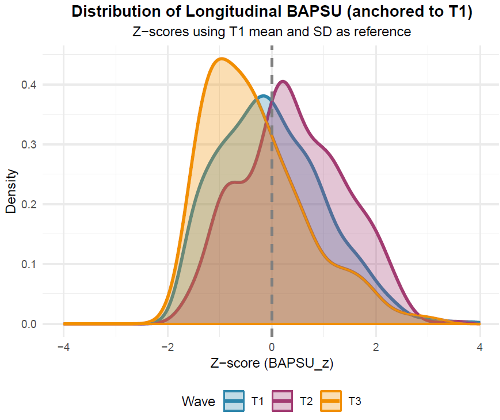
Background: Excessive screen time in early childhood is linked to behavioural dysregulation, but the role of parental practices in moderating this association over time is not fully understood. The purpose of this study is to investigate whether specific parental mediation strategies, household rules, and parental digital habits moderate both the long-term trajectory of problematic screen use and the acute, day-to-day behavioural response to screen time in children aged 2-5 years.
Methodology: A three-wave longitudinal cohort study (2024-2026) was conducted with 600 parents of children aged 2-5 years at baseline, recruited from a paediatric primary care setting in Spain. Linear mixed-effects models were employed using a within-person centring framework to isolate chronic (trait-like) from acute (state-like) effects. A unified saturated model simultaneously tested trajectory moderation (RQ1) and acute exposure moderation (RQ2), adjusting for sociodemographic covariates.
Results: The unified model revealed that the absence of a designated daily time slot was the most potent risk factor, predicting both steeper two-year behavioural worsening (RQ1: β = 0.35, p = 0.013) and significantly higher reactivity to daily screen time spikes (RQ2: β = 0.31, p = 0.001) (Figure 1). Similarly, the absence of permission-seeking routines for smartphone and television use predicted chronic trajectory decline (RQ1: β = 0.58, p = 0.033; β = 0.49, p = 0.005). Parental non-interactive screen time was found to amplify children’s acute behavioural reactivity (RQ2: β = 0.04, p = 0.023). Furthermore, a cross-sectional analysis showed that parental digital problematic use acted as a direct, independent risk pillar for child behavioural problems.
Conclusion: The structure and predictability of screen time routines are more critical than total duration in preventing problematic behaviours in early childhood. Parental digital habits represent an independent risk vector. Interventions should prioritise establishing fixed daily time slots and addressing family-wide digital environments, moving beyond a sole focus on limiting child screen time.