Background and Aims: Strong evidence has underscored the importance of upstream interventions to improve maternal and child health (MCH). A needs analysis of Singaporean Malay/Muslim women found significant gaps in MCH outcomes, with faith highlighted as a possible determinant of health compliance. Project-Achieving-Resilient-and-Inspiring Families (Project ARIF) was a pilot faith-based community programme to improve MCH among Malay/Muslims in Singapore, starting at marriage. We enrolled pregnant women who were part of Project ARIF and followed them longitudinally through their pregnancies and early parenthood journeys. We present the newborn outcomes of babies born to mothers who participated in this research study.
Methods: In Singapore, Muslim marriage solemnisers journey with their newlywed couples for the first few years of marriage to provide spiritual guidance. Doctors, nurses and social workers from KK-Women’s-and-Children’s-Hospital (KKH) leveraged on this by upskilling solemnisers with basic MCH knowledge to guide newlyweds more holistically in their early family journeys. Couples who had higher needs were referred for multi-disciplinary interventions conducted in mosques and community spaces by Project ARIF's medical team. Pregnant women were enrolled into a longitudinal study from 2022-2026. They were supported with pregnancy, lactation and postnatal counselling. They were asked to report on the outcomes of their babies at birth.
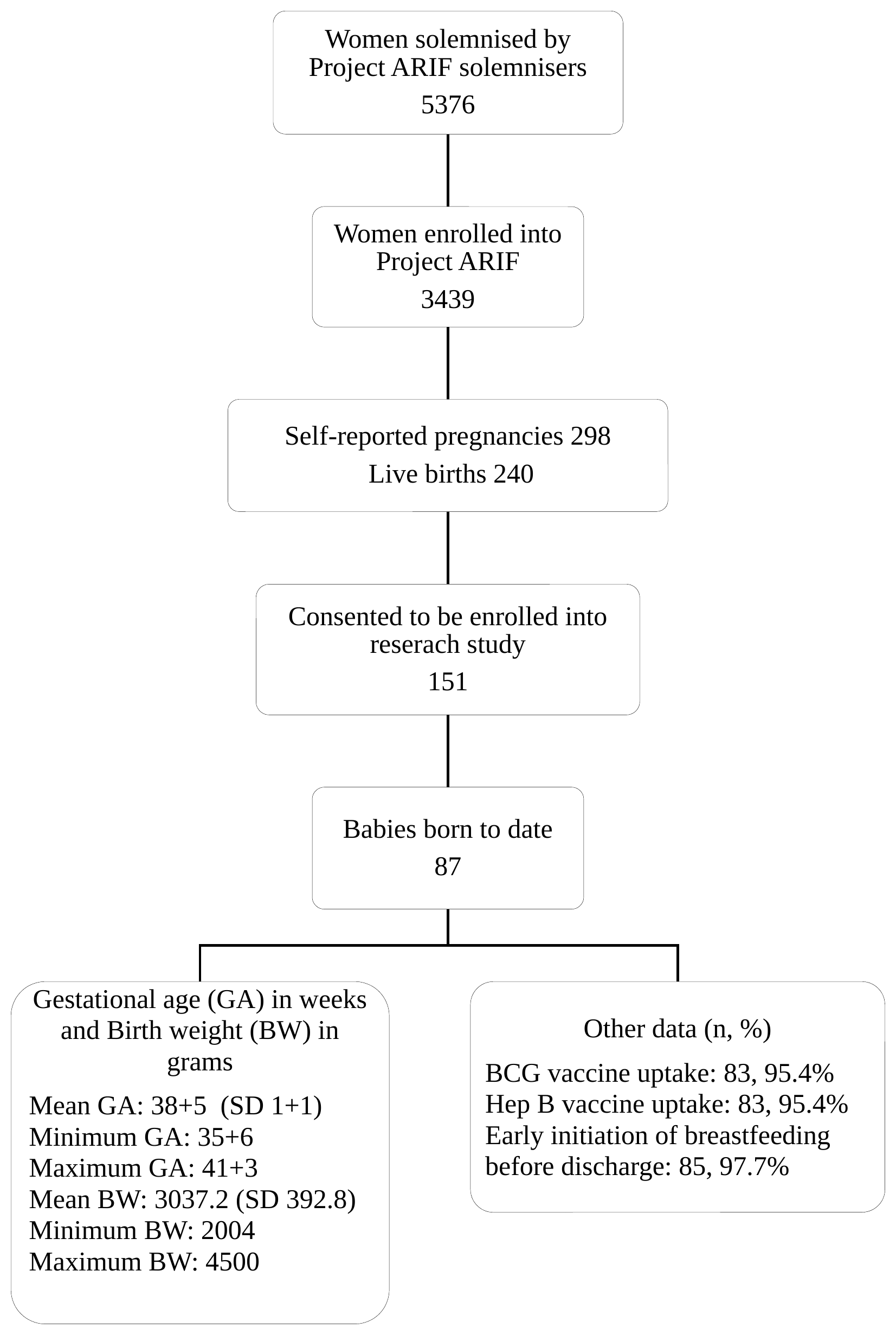
Results: 151 pregnant women were enrolled, with 87 babies born to date (Figure 1). Mothers did not report any significant antenatal complications. The mean gestational age at birth was 38+5 weeks (Standard Deviation [SD] 1+1 week), with the lowest at 35+6 weeks. The mean birth weight was 3037.2g (SD 392.8g). 92.0% of babies had normal birth weights for gestational age, and 95.4% received both nationally recommended birth vaccines - BCG and Hepatitis B. Only one baby had an eventful birth requiring admission to the Neonatal Intensive Care Unit for initial breathing difficulty. 97.7% of mothers initiated breastfeeding at birth, compared to prevalence of 49-65% reported in Singapore's National Breastfeeding and Child Feeding Survey 2021/22. All babies were discharged well with no chronic medical diagnoses.
Conclusion: Our study is the first in South-East Asia to assess a novel model-of-care; the integration of medical, social and religious support at the point of marriage to improve downstream MCH outcomes. None of the mothers in this study had antenatal complications or significantly premature births. The majority of babies born in this cohort to date had good birth outcomes, including much higher prevalence of early breastfeeding initiation, compared to national data. These preliminary findings of newborn babies born to mothers under Project ARIF are very promising, and suggest that combining faith and culture in health messaging can make a difference in MCH literacy and compliance. Strong collaborations with faith leaders and influential community figures are important avenues to improve MCH and overall population health.