Background: Adolescent mental health presentations to emergency departments (ED) are increasing across the UK. Socioeconomic deprivation is a recognised determinant of health outcomes, yet its relationship with mental health (MH) ED attendance, repeat attendance and medication burden in adolescents remains poorly characterised. This study aimed to examine these associations in a UK adolescent ED population.
Methods: A retrospective observational cohort study was conducted using ED attendance data from St. George’s Hospital (SGH) from 2024, linked with pharmacy prescription data from 2023 onwards. Patients aged 12-17 were included. The primary outcome was association between Index of Multiple Deprivation (IMD) decile (grouped into five categories) and any MH related ED attendance per patient. Secondary outcomes included repeat attendance and polypharmacy (defined as ≥3 medication orders since 2023). Associations were assessed using chi-squared tests, including for trend, and unadjusted odds ratios with 95% confidence intervals were calculated.
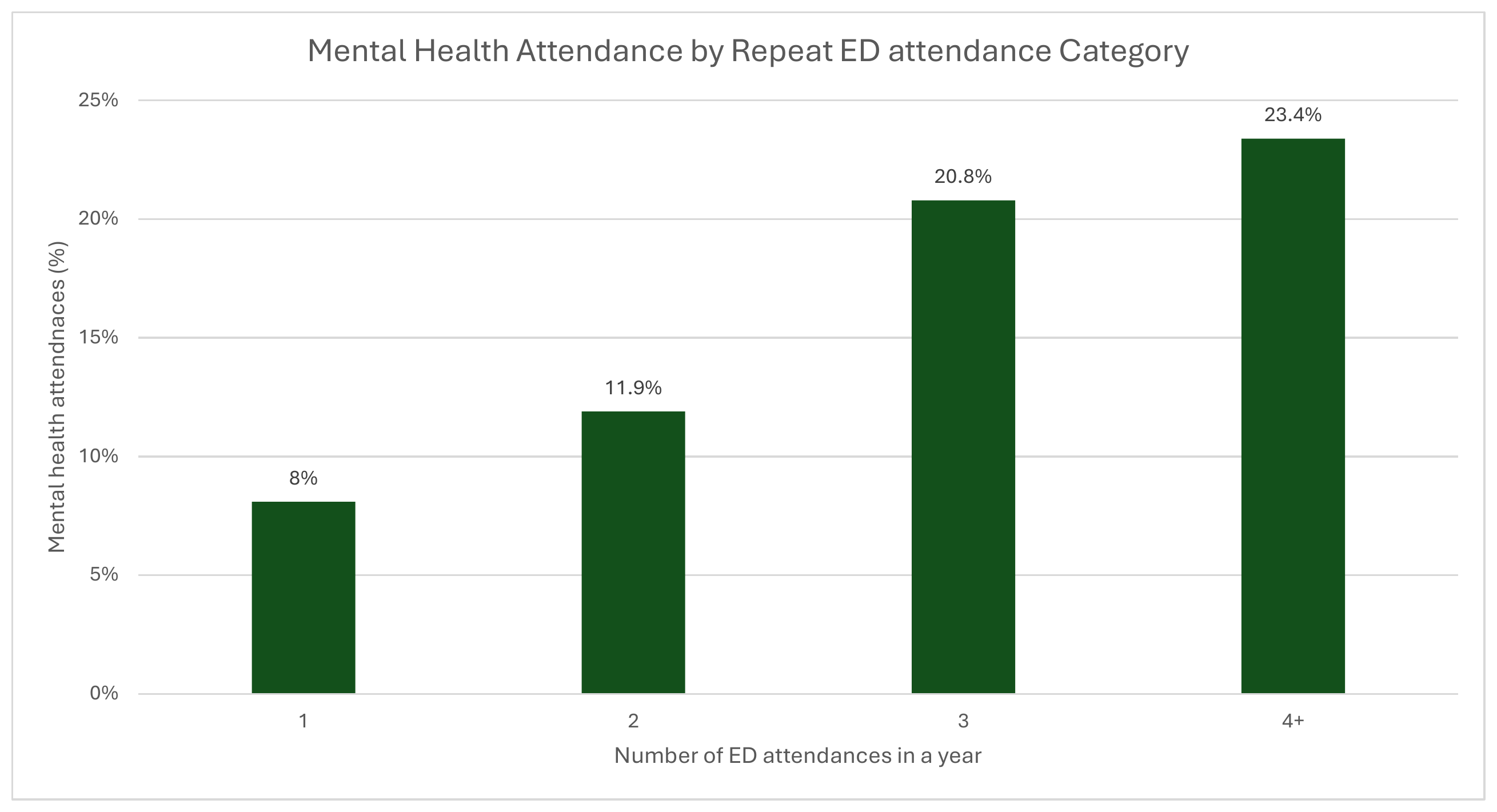
Results: 5,544 unique patients were included, comprising 7,439 attendances. The proportion of patients with at least one MH attendance was 11.3% in the most deprived group, compared to 7.5% in the least deprived group, but there was no statistically significant difference across the 5 IMD groups (p=0.128). A dose-response relationship was observed between repeat attendance and MH presentations, rising from 8.1% in single attenders to 23.4% in those attending four or more times (p<0.001) (Figure 1). Patients attending twice or more had 1.98 times the odds of a MH attendance compared to single attenders (unadjusted OR, 95% CI 1.63-2.40). Polypharmacy was present in 34.4% of patients overall and did not differ significantly by deprivation (p=0.335). It was more frequent in patients with a MH attendance than in those without (47.5% vs 33.0%; p<0.001; unadjusted OR 1.84, 95% CI 1.54-2.21).
Conclusion: Repeat attenders represent a high-risk group for MH presentations with nearly one in four of those attending four or more times having a MH presentation, highlighting the need for targeted mental health intervention and closer monitoring of frequent ED attenders. Patients with a MH attendance also had a higher cumulative medication burden. No statistically significant association between deprivation and MH attendance was detected, although a modest association cannot be excluded. This study is limited by its observational, single centre design and lack of confounder adjustment; further multi-centre studies incorporating multivariable regression are warranted.