Background: Communication and teamwork are essential for the safe management of paediatric emergencies (1). Medical students on paediatric placements often struggle to establish a purpose, with patient safety constraints limiting participation (2). In-situ Simulation (ISS) improves teamwork and communication skills in medical students (3); however, existing research focuses on medical and nursing students, with limited evidence on embedding students in ISS alongside qualified staff (4,5). Given the resource-intensive nature of simulation-based education (6), evaluating the value of integrating students into an existing paediatric interprofessional ISS programme is warranted.
Aims: To evaluate whether participation in a paediatric interprofessional ISS programme improves medical students' self-reported confidence in team role-allocation, interprofessional working, communication, and SBAR handover.
Methods: Eight fourth-year medical students from the University of Manchester were invited to join an established paediatric ISS programme within Stockport NHS Foundation Trust. They participated in a paediatric meningitis-themed simulation alongside doctors and nurses (4 students per simulation). Structured debriefs reinforced role-allocation, closed-loop communication, interprofessional working, and SBAR handovers. Students completed pre- and post-simulation Likert-scale questionnaires (1 = not at all confident; 5 = extremely confident) across these four domains.
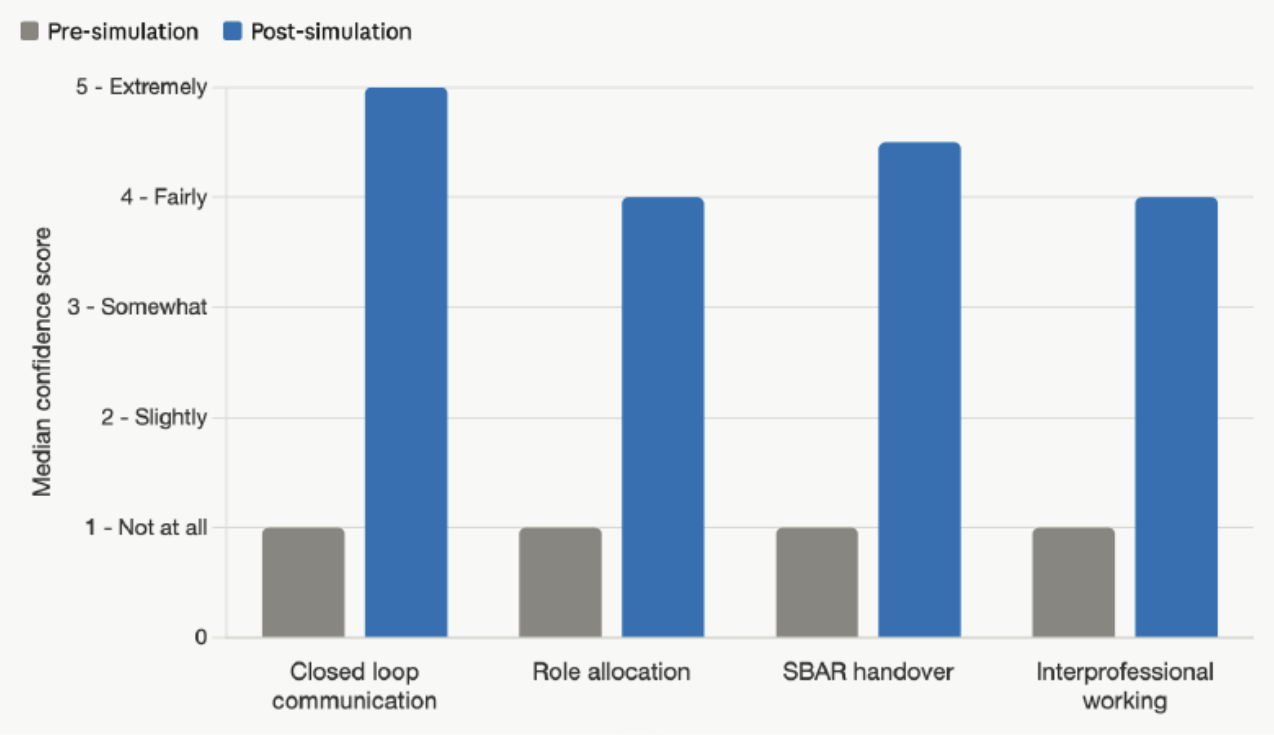
Results: Before simulation, no students reported confidence (score ≥4/5) in any domain, with median scores of 1/5 ("not at all confident") across all four domains. Following simulation, median confidence scores rose to 4/5 or higher across all domains (Figure 1). Qualitative feedback highlighted increased appreciation of teamwork.
Conclusions: Integrating medical students into established paediatric interprofessional ISS programmes is feasible and enhances self-reported confidence in the interprofessional working skills that are critical during paediatric emergencies. This may offer a time- & cost-effective strategy for paediatric teaching. Further research should evaluate objective outcomes and long-term retention.