Background: Wolff–Parkinson–White syndrome (WPW) is a congenital cardiac condition characterized by the presence of an accessory pathway (AP) between the atrium and the ventricle (Kent´s bundle). This ventricular preexcitation predisposes to 2 potentially malignant tachyarrhythmias, reentrant arrhythmias (acute supraventricular tachycardia) and accelerated conduction of atrial arrhythmias (ventricular fibrillation in patients with atrial fibrillation). Typical 12-lead electrocardiogram (ECG) characteristics of WPW include a short PR interval, a delta wave, and a wide QRS complex. But this WPW pattern can lead to a range of clinical manifestations, from asymptomatic patients to life-threatening arrhythmias. In case of recurrent or severe symptoms (palpitations, dizziness and syncope), an electrophysiological study (EPS) followed by an AP-ablation is recommended. Precise localization of the AP has clinical implications for the assessment of risk stratification and to optimize the ablation procedure (need for trans-septal puncture). There are several ECG-algorithms for AP-localization, primarily, however, they have shown to be complex, time-consuming, and often imprecise because of a variable anatomical heart axis, especially in children
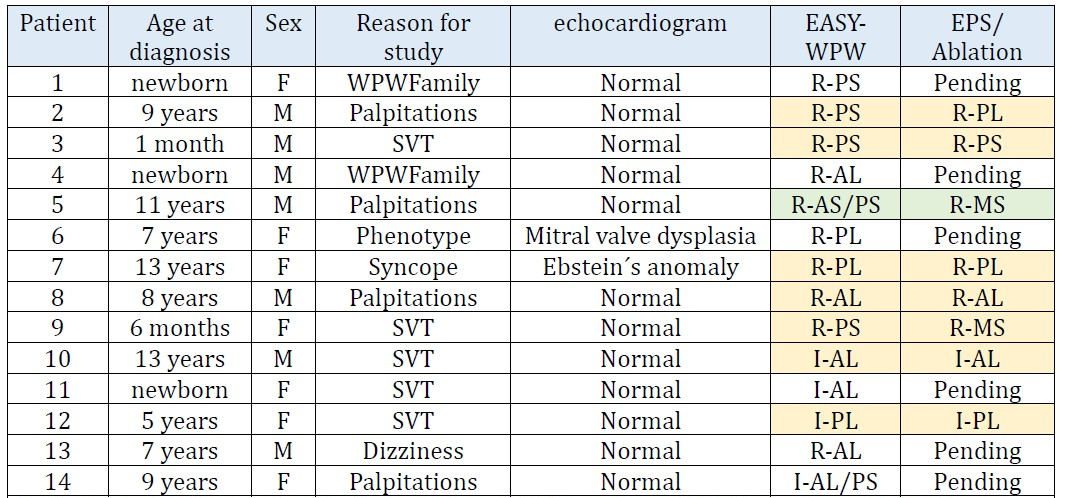
Case Summary: We conducted a retrospective and observational study that included all pediatric patients (aged <14 years) with WPW pattern in our hospital between 2010 and 2025. We reviewed all 12-lead ECGs that were recorded in sinus rhythm and demonstrated manifest ventricular preexcitation with visible delta waves. We developed the novel and simple EASY-WPW algorithm with a 2-step approach for left-sided AP and a 3-step approach for right-sided AP. We compared the location of AP predicted by EASY-WPW with the location determined by the electrophysiological study (EPS) as the gold standard. Overall, 14 patients (7 female, 7 male) with an age at diagnosis ranging from newborn to 13 years were included. The main results are shown in Table 1. This study was the subject of a Degree Final Project written by a medical student
Learning points discussion:
1. EASY-WPW algorithm was 100% accurate in predicting the lateralization of the accessory pathway.
2. EASY-WPW algorithm accurately predicted the exact location of the accessory pathway in 88% of cases.
3. We encourage general paediatricians to use ECGs in clinical practice and to overcome their fear of interpreting them
4. EASY-WPW algorithm enables reliable and accurate site determination in children with an accessory pathway.