Background: Patient-reported outcome measures (PROMs) are essential in longitudinal clinical research as they provide participants' perspectives on their health status and health-related quality of life, and track changes in these reported perspectives over time and with intervention. Remote PROM collection by email reduces the burden of physical attendance for participants; however, it is often associated with higher rates of drop-out or non-response. There has been very limited previous research comparing response rates to longitudinal PROM collection by email versus potentially more effective methods such as short message service (SMS). Furthermore, there is an even greater lack of research into response rates of parent-proxy PROMs completed on behalf of children.
Aim: The aim of this study was to compare response rates of longitudinal paediatric Patient-Reported Outcome Measure (PROM) collection by short message service (SMS) compared to email.
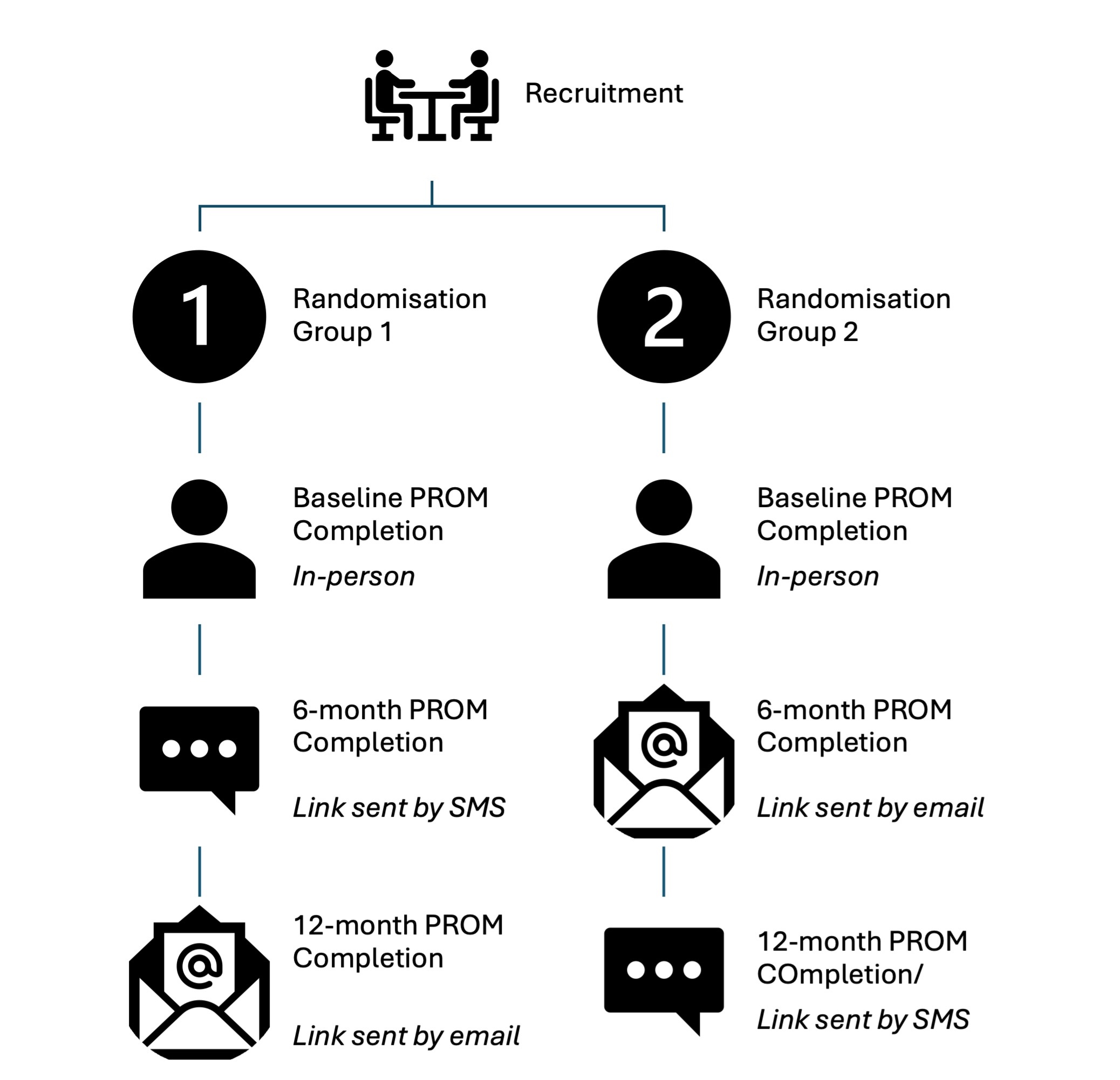
Methods: The children enrolled in a single-institution paediatric orthopaedic PROM registry were prospectively randomised to receive their 6-month follow-up web-based PROM link by SMS or email and the alternate method at their 12-month follow-up timepoint (Figure 1).
Response was analysed using mixed-effects logistic regression with participant included as a random intercept and communication method, follow-up period and randomisation sequence included as fixed effects.
Ethical approval for the study was obtained from the local Human Research Ethics Committee.
Results: During the recruitment period, a total of 500 participants were enrolled. Overall, 203 (40.6%) responded when contacted by SMS and 165 (33.0%) when contacted by email. After accounting for follow-up period, randomisation sequence and repeated observations within participants, SMS delivery was associated with significantly greater odds of response than email (adjusted OR 1.75, 95% CI 1.24-2.46; p = .001). The odds of response were lower at 12 months than at six months (adjusted OR 0.56, 95% CI 0.39-0.78; p < .001), with no evidence of an effect of randomisation sequence (OR 0.79, 95% CI 0.48-1.31; p = .36).
Conclusions: Participants were more likely to respond to a web-based PROM link sent by SMS than email, however both methods achieved a response rate below 50%. Automated electronic collection may therefore benefit from additional reminder, mixed-mode or personalised follow-up strategies.