Background: Prophylactic low-dose hydrocortisone (PLDH) has been previously shown to significantly improve survival without bronchopulmonary dysplasia (BPD) in infants born extremely preterm (<28 weeks gestational age [GA]). PLDH was subsequently introduced into clinical practice at The Jessop Wing (JW). This audit aimed to (1) review the use of PLDH in extremely preterm infants admitted to JW within 10 days of life over a 3-year period; (2) describe the outcomes of this cohort with regards to late-onset sepsis (LOS), BPD and death; (3) through sub-analysis, investigate bowel perforation rates over a 6-year period pre- and post-implementation of PLDH.
Methods: Infants born between 1 October 2022 and 30 September 2025 at less than 28 weeks' gestation and admitted to JW within 10 days of life were included in this analysis (post-PLDH implementation cohort). Data were retrospectively collected using electronic medical records (EPR) with BadgerNet Neonatal EP by independent clinicians and included PLDH treatment, demographic and mortality data. LOS was confirmed by a positive blood culture result or suggestive chest X-ray changes. BPD was defined by ongoing respiratory support at >36 weeks GA. Statistical analysis was performed using Pearson’s chi-squared test with IBM SPSS 28.0.
Perforation was defined based on surgical or radiological evidence and, where possible, further categorised. A sub-analysis examined perforation rates before and after PLDH implementation. Data were collected for infants born between 1 October 2019 and 30 September 2022 (pre-PLDH cohort). Infants in the post-PLDH cohort who did not receive PLDH were excluded.
Results: In total, 196 infants were born within the post-PLDH implementation study period and met the inclusion criteria. 171 (87.2%) of these received PLDH and 25 (12.8%) did not. Those who received PLDH had a higher rate of LOS (54% vs 28%, χ² 6.077, p=0.014), but a lower mortality rate (22% vs 48%, χ² 8.085, p=0.004) compared to those who did not receive PLDH. Conversely, PLDH was not associated with significantly different BPD rates (57% vs 48%, χ² 2.76, p=0.096).
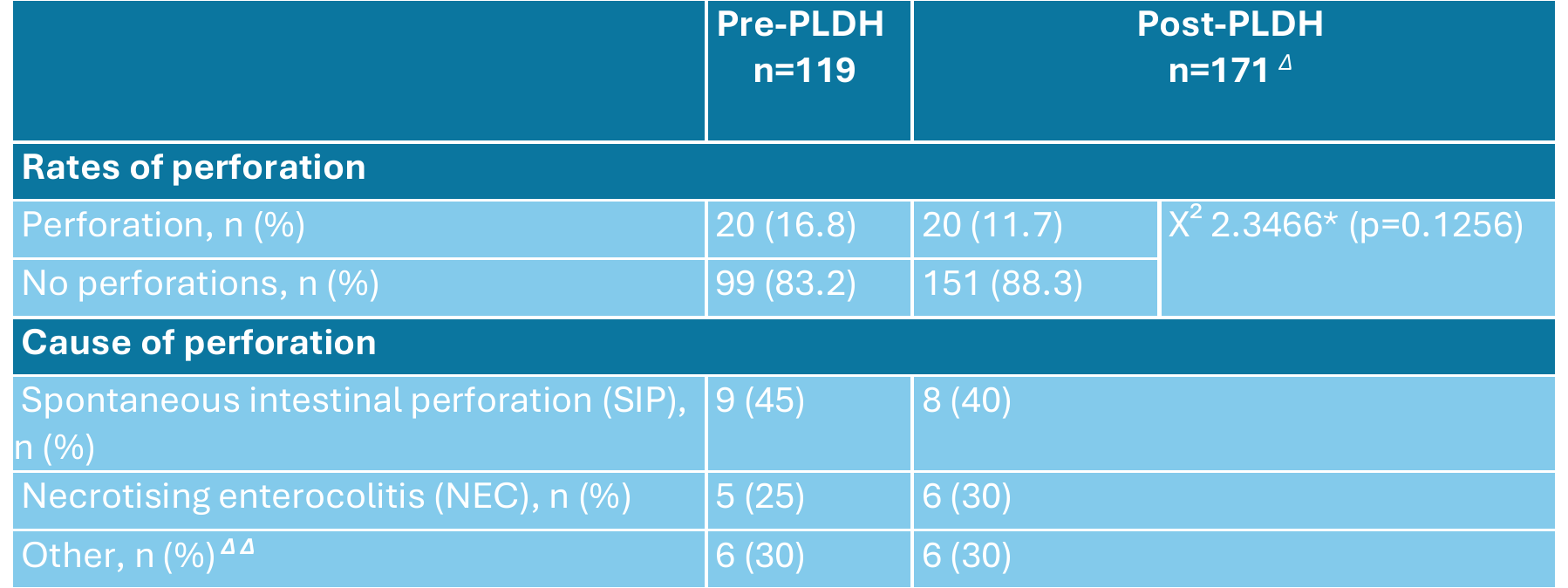
The sub-analysis (Table 1) demonstrated no statistically significant difference in perforation rates between the pre- and post-PLDH cohorts. Spontaneous intestinal perforation accounted for the largest proportion of perforations in both cohorts, with a similar distribution of perforation aetiologies observed between groups. It was not always possible to determine the definitive cause of perforation from the EPR; therefore, cases with an unknown cause, as well as alternative causes such as intussusception, intestinal malrotation, and ischaemia, were categorised under “Other”.
Conclusions: This retrospective analysis describes real-world outcomes in a large cohort of infants receiving PLDH over three years at a tertiary centre. In the post-implementation cohort, PLDH was associated with lower mortality but higher rates of late-onset sepsis. Sub-analysis showed bowel perforation rates were comparable across both pre- and post-PLDH cohorts.
Interpretation of LOS, BPD, and survival outcomes is limited by the small number of infants not receiving PLDH in the post-implementation cohort and should be treated with caution. Further study of this data will adjust for gestational age and high dose steroid exposure as confounding factors.