Background: Eating disorders are serious psychiatric conditions with important medical and psychological consequences in children and adolescents, including malnutrition, bradycardia, cardiovascular instability, self-harm, and increased risk of suicide. Adolescence is a particularly vulnerable stage, as body image is still developing, and exposure to social media, and idealized beauty standards may increase body dissatisfaction and unhealthy eating behaviors. Data on pediatric and adolescent eating disorders, as well as factors associated with hospital admission, remain limited in Qatar and the Middle East and North Africa (MENA) region. This study aimed to describe the clinical and psychiatric characteristics of children and adolescents with eating disorders in Qatar and identify factors associated with hospital admission.
Methods: A retrospective cohort study was conducted using data from Sidra Medicine and Hamad General Hospital (HGH) in Qatar. Children and adolescents aged 6–18 years diagnosed with eating disorders between December 2016 and December 2025 were included. Patients with incomplete medical records were excluded. Demographic, clinical, anthropometric, heart rate, admission status, and psychiatric comorbidity data were extracted from medical records. Ethical approval was obtained from the Sidra Medicine Institutional Review Board (IRB 1929504). Data were analyzed using IBM SPSS Statistics version 26 and GraphPad Prism version 10.1.2. Descriptive statistics were used to summarize patient characteristics. Comparisons between admitted and non-admitted patients were performed using chi-square or Fisher’s exact tests for categorical variables and independent t-tests or Mann–Whitney U tests for continuous variables. Statistical significance was set at p < 0.05.
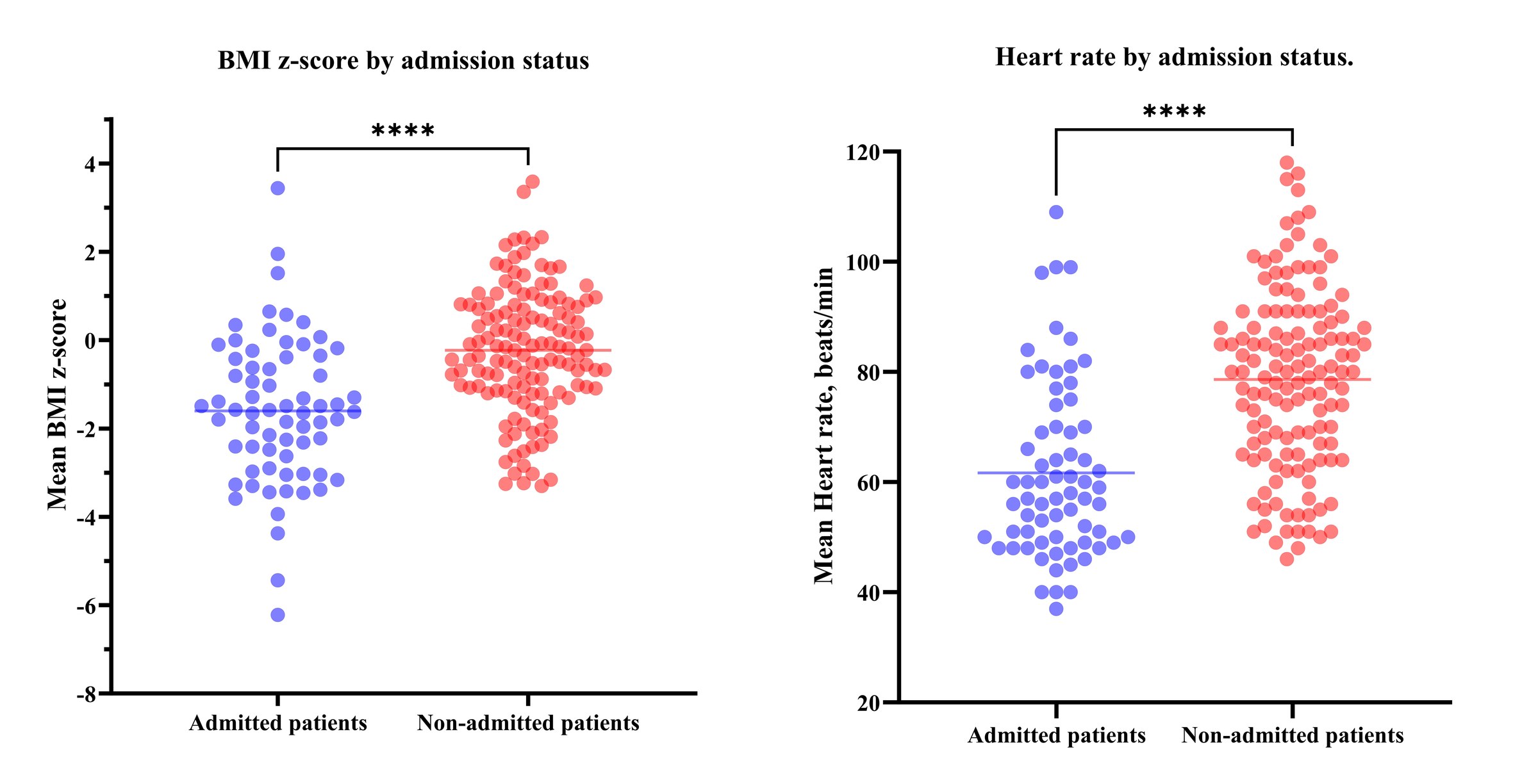
Results: A total of 204 children and adolescents with eating disorders were included. The mean age and BMI z-score were 14.21 ± 2.02 years and -0.688 ± 1.62, respectively. 188 patients were female (92.2%), and 68 patients (33.3%) required hospital admission, while 136 (66.7%) were managed in the outpatient clinic. The most frequent diagnosis was anorexia nervosa–restricting type (AN-R) in 106 patients (52.0%), followed by anorexia nervosa binge-eating/purging type in 38 (18.6%), other specified feeding or eating disorder (OSFED) in 36 (17.6%), bulimia nervosa in 13 (6.4%), and avoidant/restrictive food intake disorder (ARFID) in 11 (5.4%). Psychiatric comorbidities were common, including depression in 59.8%, anxiety in 46.6%, suicidal ideation and/or suicide attempt in 19.1%, and self-harm in 14.2%. Compared with non-admitted patients, admitted patients had significantly lower BMI z-scores [−1.60 ± 1.65 vs −0.23 ± 1.41, p < 0.001] and lower mean heart rate [61.68 ± 15.97 vs 78.64 ± 16.46 beats/min, p < 0.001] (Figure 1). Bradycardia and thinness/severe thinness were present in 64% and 60% of admitted patients, respectively, and were significantly associated with admission (p < 0.001). In contrast, no significant association was found between psychiatric comorbidities and admission status.
Conclusion: Pediatric eating disorders in Qatar were predominantly seen among adolescent females, with AN-R type being the most common subtype. Hospital admission was mainly associated with lower BMI z-score, bradycardia, and thinness/severe thinness, rather than psychiatric comorbidities. These findings highlight the need for early screening, close cardiovascular and nutritional assessment, and clear referral pathways to identify high-risk patients requiring inpatient care. Multidisciplinary management involving pediatricians, psychiatrists, dietitians, and families is essential to improve early intervention and outcomes.