Background: Evidence-based weight management strategy recommendations exist for youth; however, few studies have examined actual weight management strategies utilized by youth. The objective of this study was to examine weight perceptions among, and weight management strategies utilized by US youth aged 8-15 based on age, gender, and race/ethnicity from the 2011-2012 National Health and Nutrition Examination Survey (NHANES).
Methods: A cross-sectional secondary data analysis was conducted using the NHANES 2011-2012. Participants included a total of 1,152 US youth aged 8-15 years from a nationally representative sample. Prevalence of weight management strategies was assessed for the entire sample, gender, race/ethnicity, and age categories. Tests of main effects were conducted for weight management strategies based on gender, race/ethnicity, and age categories. Follow-up tests of paired prevalence were conducted using analysis of variance and least square means comparisons. Statistical significance was set at P<0.01 and no other adjustment to P values was made for the multiple hypotheses tested. All analyses followed the NHANES data analysis protocol, including the use of appropriate sample weights. Statistical analyses were conducted using the Statistical Analysis Software (SAS, version 9.4).
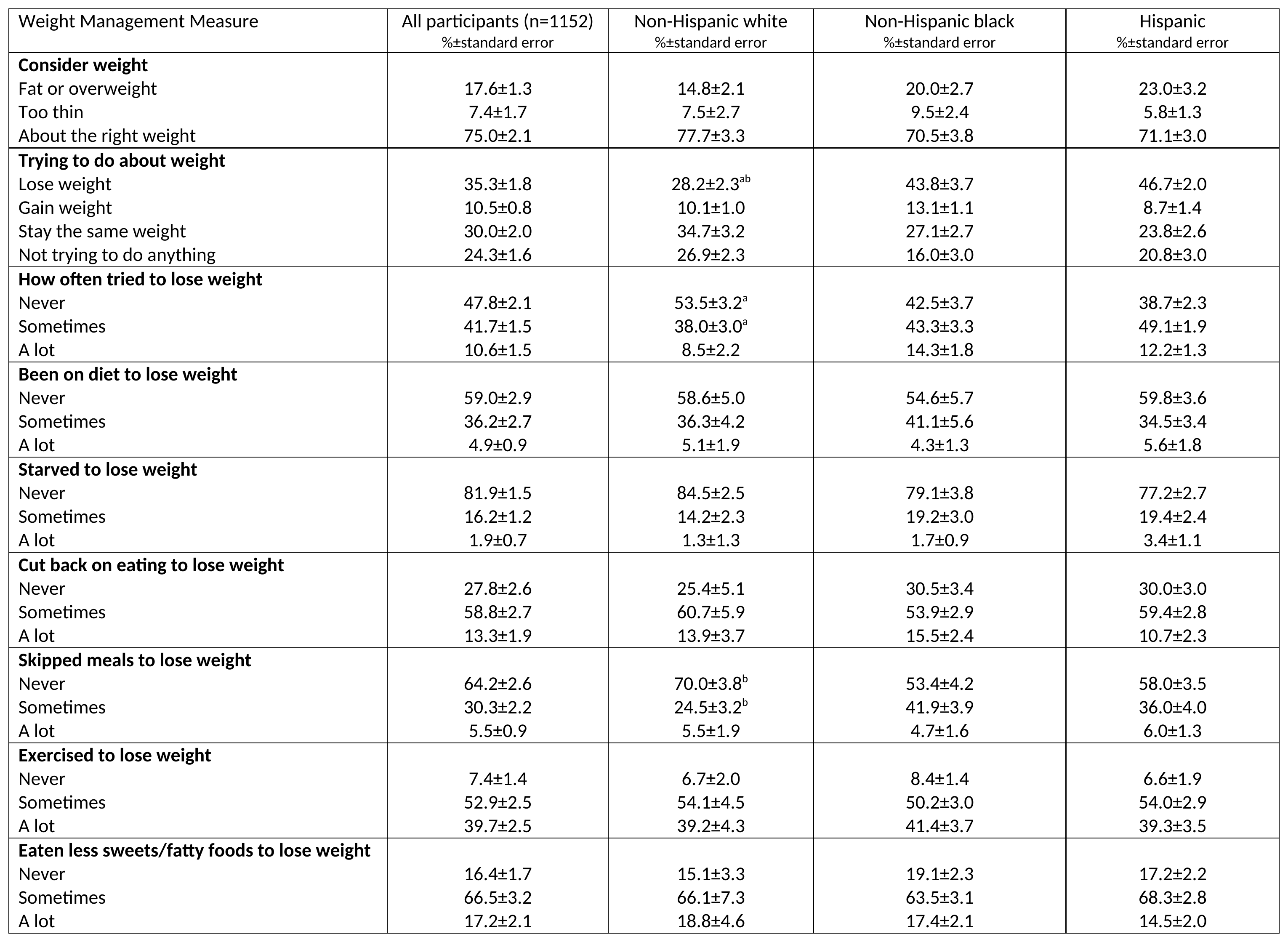
Results: Mean age of participants was 11.6±0.1 years. Approximately 35.3±1.8% of participants reported trying to lose weight. Notable weight loss strategies utilized by participants included dieting to lose weight (sometimes, 36.2±2.7%), cutting back to lose weight (sometimes, 58.8±2.7%), skipping meals to lose weight (sometimes, 30.3±2.2%), exercising to lose weight (sometimes, 52.9±2.5%; a lot, 39.7±2.5%), and eating less sweets or fatty foods to lose weight (sometimes, 66.5±3.2%). Significantly (P<0.01) more non-Hispanic blacks (43.8±3.7%) and Hispanics (46.7±2.0%) reported trying to lose weight compared to non-Hispanic whites (28.2±2.3%) (Table 1). Significantly (P<0.01) more non-Hispanic whites (53.5±3.2%) reported never trying to lose weight than Hispanics (38.7±2.3%). In addition, significantly (P<0.01) more non-Hispanic whites (70.0±3.8%) reported never skipping meals to lose weight compared to non-Hispanic blacks (53.4±4.2%). Significantly more males (15.4±1.6%) reported trying to gain weight than females (5.7±1.4%). Prevalence of skipping meals a lot to lose weight increased across age groups with significantly (P<0.01) more ≥13-year-old participants (10.6±2.7%) reporting skipping meals a lot compared to those >10 to <13 years (2.0±1.0%). Finally, significantly (P<0.01) more >10 to <13-year-old participants (8.4±2.2%) reported being on a diet to lose weight a lot compared to ≥13-year-old participants (2.2±0.7%).
Conclusion: Race/ethnicity, gender, and age may influence various weight management perceptions and strategies utilized among youth. Knowledge about the prevalence of weight management strategies utilized in youth and possible demographic factors that influence these behaviors could assist practitioners in developing targeted strategies to promote body positivity and healthy weight management strategies for this population.