Background: Autism spectrum disorder (ASD) is traditionally defined as a neurodevelopmental condition characterized by significant clinical and biological heterogeneity, with no established biologically grounded classification system. Although growing evidence implicates immune dysregulation and neuroinflammation in subsets of individuals, these findings remain inconsistently integrated into clinical practice and diagnostic frameworks. This work aims to propose a sustained neuroinflammatory developmental framework for ASD and to introduce a phase-based clinical model that may better explain variability in disease onset, progression, and therapeutic response.
Methods: A narrative and integrative synthesis of evidence from neuroimmunology, developmental neuroscience, and clinical observations was conducted. Published data on microglial activation, cytokine dysregulation, autoimmune encephalitis, and neurodevelopmental regression were examined and conceptually unified to construct a biologically informed model linking immune activation to neurodevelopmental outcomes in ASD.
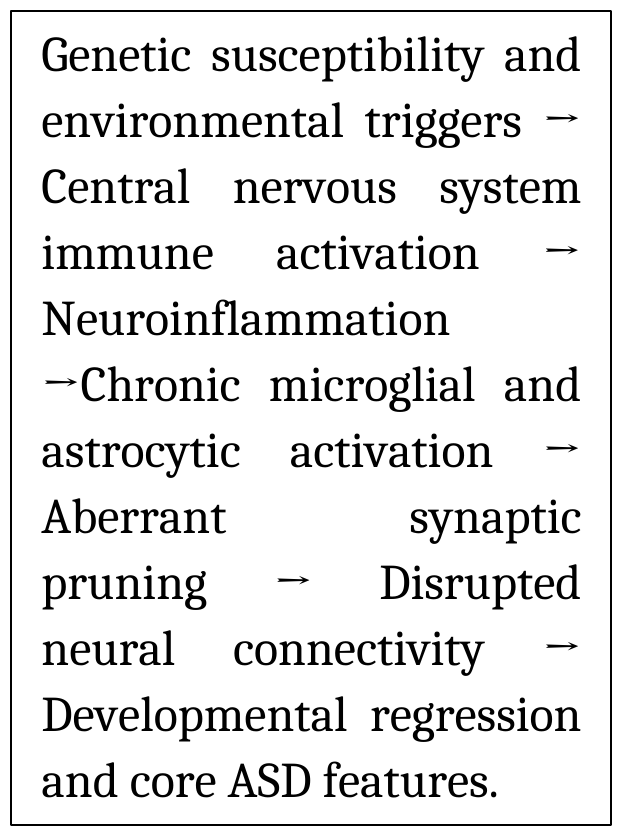
Learning Points: ASD, in a biologically defined subgroup, may originate from systemic immune activation in genetically or epigenetically susceptible individuals, leading to a sustained neuroinflammatory developmental process . This process may manifest clinically as developmental regression or early behavioral changes accompanied by features suggestive of active neuroinflammation. Persistent microglial activation, elevated inflammatory biomarkers in blood and cerebrospinal fluid, and synaptic dysfunction may underlie these neurodevelopmental changes. Over time, patients may transition to a phase characterized by major neurobiological sequelae, followed by an established neurodevelopmental state in which core behavioral symptoms persist despite reduced or absent detectable inflammatory markers. This temporal evolution may explain variability in biomarker detection across individuals and disease stages (Figure 1).
A phase-based clinical model can be proposed, categorizing patients into:
(1) an active neuroinflammatory stage,
(2) a stage of major neurobiological complications, and
(3) an established neurodevelopmental stage characterized predominantly by core behavioral symptoms.
This model supports symptom-based clinical stratification and provides a framework for stage-oriented therapeutic decision-making. Early identification of the inflammatory phase may allow targeted immunomodulatory or neuromodulatory interventions, while later stages may benefit from tailored supportive and rehabilitative strategies.
Discussion: This framework provides a biologically coherent explanation for the heterogeneity observed in ASD and offers a potential bridge between neurodevelopmental and neuroimmunological models. The proposed phase-based classification may facilitate early identification of patients in an active neuroinflammatory stage, where targeted immunomodulatory or neuromodulatory interventions could alter disease trajectory. In later stages, management may shift toward addressing established neurobiological sequelae and optimizing supportive and rehabilitative strategies. Importantly, this model may help explain inconsistencies across biomarker studies and variability in treatment response reported in the literature. If further explored and validated, this approach could contribute to the development of a clinically applicable classification system and enable more personalized, stage-based management strategies for ASD.