Background: Tic disorders are common neurodevelopmental conditions in childhood and may range from transient, mild symptoms to more persistent disorders associated with functional impairment. In Vietnam, data on the clinical severity of tic disorders assessed by standardized instruments remain limited. The Yale Global Tic Severity Scale (YGTSS) is widely used to quantify both tic severity and tic-related impairment. This study aimed to describe the severity profile of tic disorders in children attending the National Children’s Hospital in 2025 and to identify factors associated with greater severity.
Methods: A cross-sectional descriptive study was conducted among 176 children aged under 18 years diagnosed with tic disorders according to ICD-10 criteria at the National Children’s Hospital from January to September 2025. Eligible participants had not received prior pharmacological or psychological treatment for tic disorders. Tic severity and functional impairment were assessed by clinicians using the YGTSS. Descriptive statistics were used to summarize demographic and clinical characteristics. Group comparisons were performed using appropriate parametric or non-parametric tests. Multivariable linear regression was used to examine associations between clinical factors and tic severity.
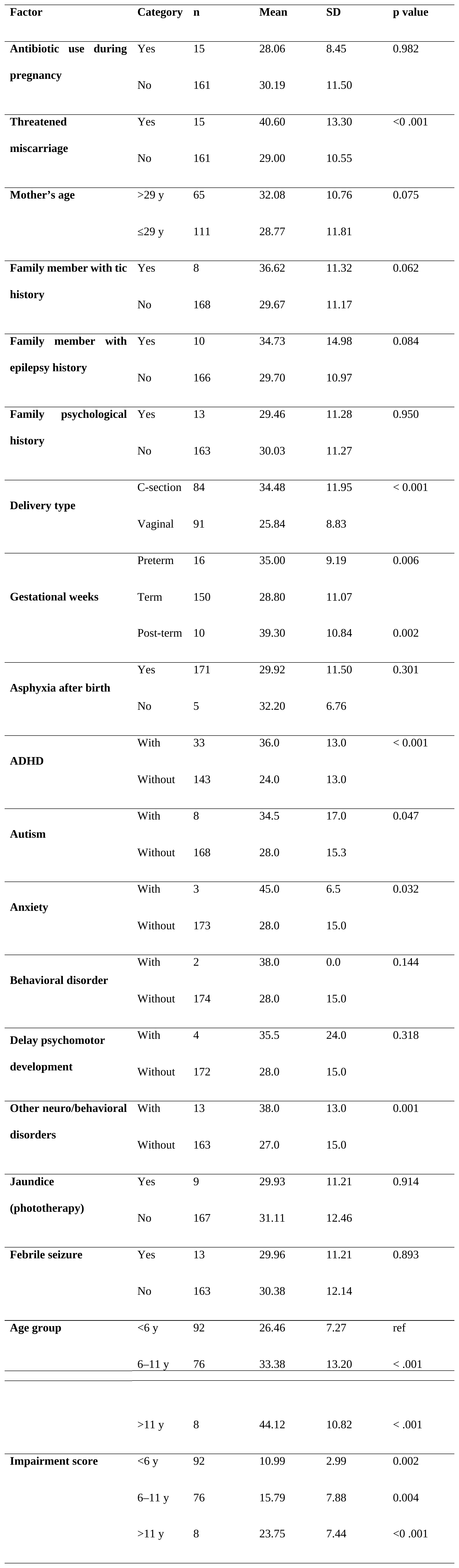
Results: Among 176 children with tic disorders, the mean YGTSS Global Severity Score was 30.0 ± 11.2 (median 28.0, IQR 15.0; range 17.0-77.0). Most patients had moderate severity (51.7%), followed by mild (45.5%) and marked severity (2.8%). Tic severity increased with age, from 26.46 ± 7.27 in children aged <6 years to 33.38 ± 13.20 in those aged 6-11 years and 44.12 ± 10.82 in those aged >11 years (both p<0.001). Higher severity was associated with threatened miscarriage (40.60 ± 13.30 vs 29.00 ± 10.55, p=0.0002), caesarean delivery (34.48 vs 25.84, p<0.005), and non-term birth, including preterm and post-term delivery (p=0.002). Children with ADHD had significantly higher severity scores than those without ADHD (36.0 ± 13.0 vs 24.0 ± 13.0, p<0.001). Greater severity was also observed in children with autism spectrum disorder (p=0.047), anxiety (p=0.032), and other behavioral disorders (p=0.001). No significant associations were found for antibiotic exposure during pregnancy, jaundice requiring phototherapy, or febrile seizures (Table 1).
Conclusion: In this hospital-based sample, tic severity was generally mild to moderate; however, increasing age, threatened miscarriage, caesarean delivery, preterm or post-term birth, and comorbid ADHD were identified as factors associated with greater tic severity. These findings suggest that perinatal adversity and neurodevelopmental comorbidity may contribute to a higher tic burden and should be considered in the early clinical assessment and risk stratification of children with tic disorders.