Background: Influenza remains an important cause of pediatric hospitalization and continues to place a substantial burden on emergency and inpatient services. Data on the clinical presentation, complications, and outcomes of hospitalized children with influenza in Albania are limited. This study aimed to describe the prevalence, clinical characteristics, laboratory findings, complications, and outcomes of laboratory-confirmed influenza among hospitalized children and to compare them with influenza-negative cases.
Methods: We conducted a prospective cohort study at the University Hospital Center “Mother Teresa”, Tirana, Albania, including hospitalized children who had at least fever or cough and underwent nasopharyngeal RT-PCR testing during 1 January 2024–1 April 2024 and 30 October 2024–1 April 2025. Children were categorized as influenza-positive or influenza-negative. Demographic and clinical data were collected using standardized study forms, while laboratory, complication, and outcome data were completed from medical records. Categorical variables were compared using the chi-square test or Fisher’s exact test, and continuous variables using the Mann–Whitney U test, as appropriate. Statistical analyses were performed using IBM SPSS Statistics.
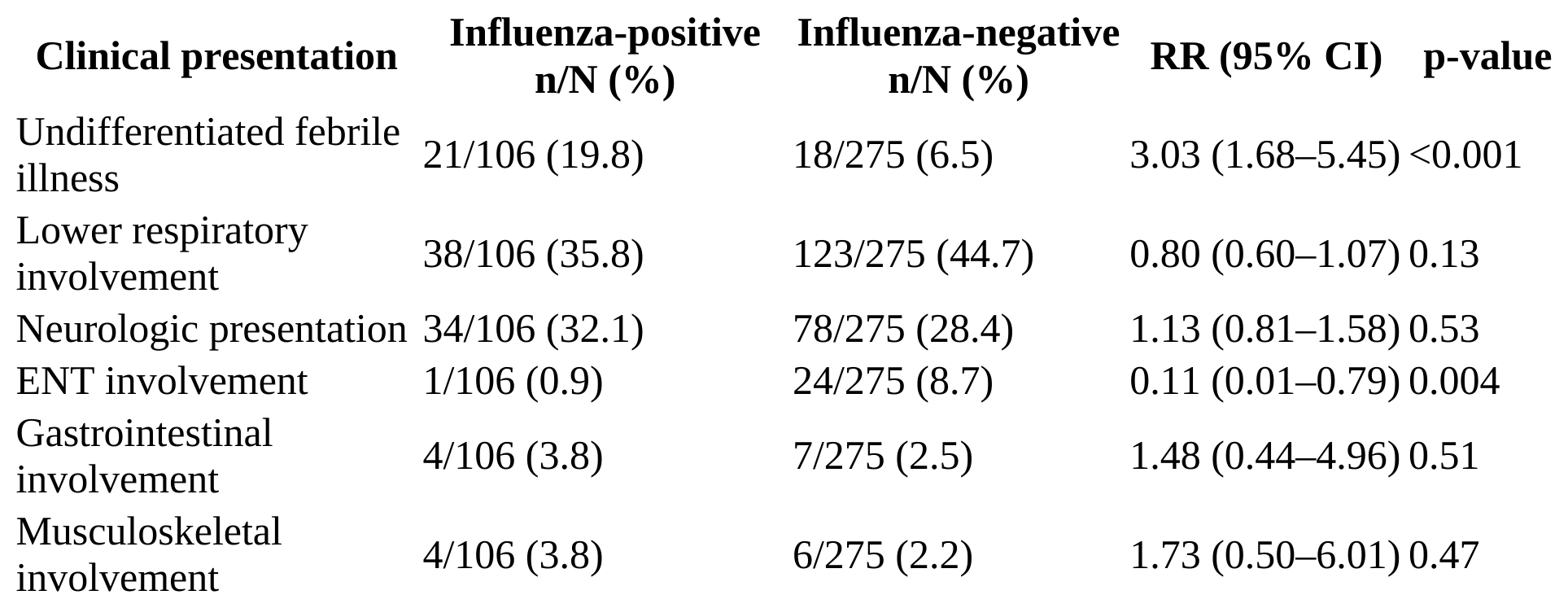
Results: Of 385 samples analyzed, 106 (27.5%) were positive, 275 (71.4%) were negative, and 4 (1.0%) yielded no result. Among positive cases, A(H1N1) was the most frequently identified agent (43/106, 40.6%), followed by B (33/106, 31.1%) and A(H3N2) (30/106, 28.3%); no A(H2N2) cases were detected. Positive cases were most frequent among children aged 1–4 years (55/106, 51.9%), with a median age of 3.4 years (IQR, 1.9–5.9). More positive cases were recorded during the 2023–2024 influenza season than during the 2024–2025 season (58/106 [54.7%] vs 48/106 [45.3%]). Hospital stay was longer in negative than in positive cases (median, 6 vs 5 days; p=0.006). Fever was the most common presenting feature (182/385, 47.3%), febrile seizures were recorded in 105/385 children (27.3%). Duration of fever did not differ significantly between positive and negative cases (median, 4 days [IQR, 3–7] vs 4 days [IQR, 2–7]; p=0.82). Influenza-positive children were more likely to have moderate-to-severe fatigue than influenza-negative children (22.9% vs 12.4%; RR 1.85, 95% CI 1.15–2.97; p=0.016). Positive cases had lower absolute neutrophil and lymphocyte counts than negative cases (ANC: 5.0 vs 6.1, p=0.0006; ALC: 2.2 vs 3.5, p<0.001). Complications were more frequent in positive than in negative cases (15.1% vs 10.9%), although the difference was not statistically significant (RR 1.38, 95% CI 0.79–2.43; p=0.29). Among influenza-positive children, complications occurred in 16/106 cases (15.1%); myositis was the most frequent complication (4/106, 3.8%), followed by acute otitis (2/106, 1.9%), enteritis (2/106, 1.9%), encephalitis (1/106, 0.9%), meningitis (1/106, 0.9%), and pneumonia (1/106, 0.9%). Transfer to the intensive care unit was uncommon and did not differ significantly between positive and negative cases (1/106 [0.9%] vs 4/275 [1.5%];). After clinical regrouping by organ-system involvement, influenza-positive children were more likely to present with an undifferentiated febrile illness than influenza-negative children (19.8% vs 6.5%; RR 3.03, 95% CI 1.68–5.45; p<0.001). Table 1.
Conclusions: Among 385 patients, 366 (95.3%) improved,18 (4.7%) initially worsened but subsequently improved; no deaths were recorded. These findings highlight the heterogeneous clinical presentation of influenza in hospitalized children and support the value of early virologic testing for timely diagnosis and management, and reinforce the importance of influenza vaccination to reduce disease burden, severity, and hospitalization in children, as the Center for Disease Control and Prevention recommends.