Background: Cancer is a leading cause of death in children and adolescents, with 400,000 cases diagnosed annually, mostly in low- and middle-income countries, where there are lower survival rates compared to higher-income nations. In the Philippines, the 5-year survival rate is between 25% and 50%. A study on childhood cancer in Southeast Asia highlights the significant burden of pediatric cancer care in the Philippines, including direct costs of diagnosis and treatment; indirect costs of transportation, lost income, and caregiver time; and psychosocial impacts such as sibling anxiety, caregiver stress, and guilt. Pediatric cancer causes a lot of stress and anxiety for both the child and their family, worsened by a lack of resources and a reliance on traditional medicine. Strong parental support is associated with improved quality of life during treatment, while post-treatment quality of life is linked to normalcy and life satisfaction. Coping mechanisms and health-related quality of life are increasingly recognized as key factors in managing disease burden. This study examined caregiver coping strategies and child quality of life to guide interventions that reduce disease burden and enhance survivorship.
Method: The prospective study investigated 150 pairs of caregivers and children at a tertiary hospital, evaluating how the primary caregiver's coping strategies, measured by the Filipino Coping Strategies Scale (FCSS), relate to the child's quality of life, assessed using the Pediatric Quality of Life Inventory (PedsQL™), among children with cancer aged 5 to 18 who have been receiving chemotherapy for at least three months. Those not involved in direct patient care, children admitted for other medical issues, those unable to complete the questionnaires, and those with amputation or impaired cognition due to cancer are excluded. The FCSS Questionnaire measures coping behaviors, encompassing the nine domains of coping—cognitive reappraisal, social support, problem-solving, religiosity, tolerance, emotional release, overactivity, relaxation or recreation, and substance use. The age-appropriate PedsQL™ Scale Questionnaire version 4.0 evaluated four domains of functioning: physical, emotional, social, and school. Descriptive statistics were used to summarize the sociodemographic profiles of the dyads expressed in frequencies and percentages. Inferential statistics, specifically the Pearson R correlation was used to ascertain whether there is a positive relationship between the mean scores of the coping mechanisms and the quality of life of the children. A p-value of < 0.05 was considered significant.
Results: Age significantly influenced quality-of-life scores among children with cancer, with a statistical significance of p = 0.022: those aged 5 to 7 years reported the highest mean score (117.2), followed by those aged 8 to 12 years (115.7) and adolescents aged 13 to 18 years (90.3).
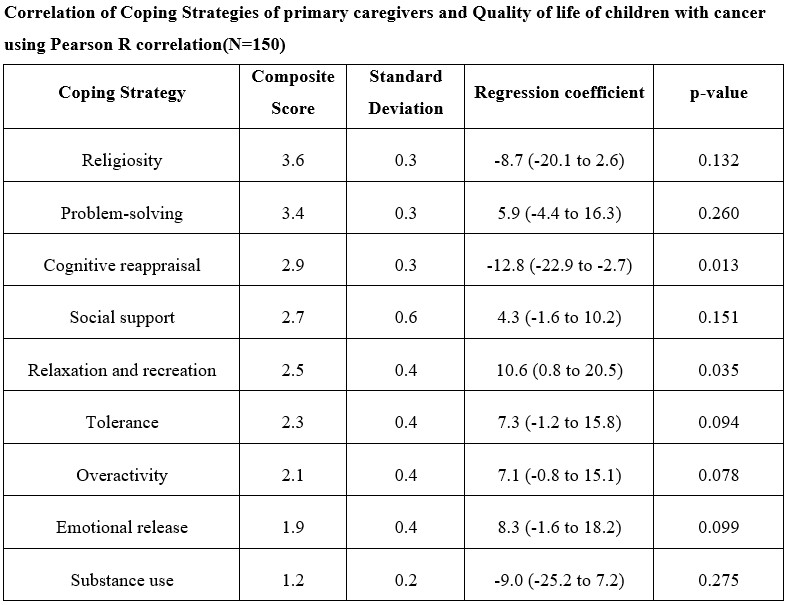
Conclusion: The cognitive reappraisal coping strategy employed by the majority of the primary caregivers has a composite score of 2.9 with a significant regression coefficient of -12.8 (p-value 0.013) when correlated with PedsQL. Even though cognitive reappraisal is a helpful strategy, it showed a negative relationship with PedsQL scores, suggesting that when caregivers distance themselves emotionally, it might lower how children feel about their quality of life and could increase their emotional distress. Relaxation and recreation had a composite score of 2.5 with a coefficient of 10.6 (p-value 0.035), indicating a statistically significant positive impact on children's quality of life. (Table 1) These findings identify targets to enhance holistic cancer care for children and families.