
Excellence in Pediatrics is a non-profit association dedicated to advancing pediatric healthcare.
Rue des Vignerons 18, 1110 Morges 1 (VD), Switzerland
email: secretariat@ineip.org
tel. +41 43 21 55 937



This Issue
Child poverty is linked to falling vaccination rates. The implication is also clear: you cannot clinic your way out of an inequality that is rooted in the social conditions of children’s lives.
Context
In the United Kingdom, childhood vaccines are provided at no cost to families, and yet, vaccination rates fall in deprived areas. This pattern is consistent across major childhood vaccines, and it is neither a coincidence nor a mystery. Prof. David Taylor-Robinson showed that childhood vaccination uptake in England follows a clear social gradient, with consistently lower coverage in more deprived areas and widening inequalities over time.
In RSV prevention, the key question is about who gets seriously ill. In a large US study, 65.8% of infants admitted to intensive care for RSV were born as healthy, full-term babies. You cannot predict in advance which infant will become critically ill, and that unpredictability is the argument for universal protection.
The mechanisms are clear once we look beyond the assumption that “free” means accessible. Vaccination requires commuting, time away from work, and repeated visits, all of which carry real costs for families facing financial insecurity. At the same time, child poverty rose sharply after 2008, and the services placed to absorb this burden were reduced. ‘Sure Start’ centers – UK early years and family support programs – faced deep funding cuts, health visitor capacity contracted, and community outreach declined. The result was a loss of the local knowledge and relationships that had sustained vaccination uptake in these communities.
For policy, the implications are clear. As Professor Sir Terence Stephenson noted at the Summit, “there is no magic bullet.” No communication strategy or service redesign can offset the effects of high levels of child poverty on families’ ability to engage with services. Reducing child poverty is not an addition to vaccination equity; it is a prerequisite. This requires proportionate universalism: maintaining universal programs while directing greater support to those facing the greatest barriers, alongside sustained investment and treating vaccination equity as a core system objective.
The EiP Vaccination Equity Campaign presents the shared commitments and Action Framework for vaccination equity from the December 2025 LifeCourse Prevention Summit, a concrete agenda for moving from analysis to implementation.
Featured Interview

Key Points from the Interview
Five things Prof. Taylor-Robinson’s research reveals about the relationship between poverty, policy, and vaccination:
There is a perfect social gradient in childhood vaccination in England
Vaccination rates decline at every step down the social gradient across all vaccines studied. This gradient is longstanding and has accelerated since COVID-19.
Child poverty is a key driver of vaccination coverage
Increases in child poverty are associated with declines in MMR coverage, indicating that reducing poverty is central to improving vaccination uptake.
Poverty works through concrete, traceable mechanisms
For families facing access barriers, these mechanisms translate poverty into missed vaccinations, and they are, in principle, modifiable.
Cutting early years services in deprived areas made everything worse
Years of austerity after 2008 cut the preventive services, including Sure Start centers, health visiting, and community outreach, that had sustained vaccination uptake where it was needed the most.
There is no single solution, but reducing child poverty is a prerequisite
Reducing child poverty and restoring investment in preventive services are the conditions on which everything else depends.
The Report
“Poverty isn’t being mediated through parents not being able to afford the vaccine. It must be through a mixture of: it’s a proxy for lack of education, it’s a proxy for failure to be able to access the services, it’s a proxy for both parents having to work full time to make ends meet.”
Professor Sir Terence Stephenson, December 2025 LifeCourse Prevention Summit
From the Summit Briefings
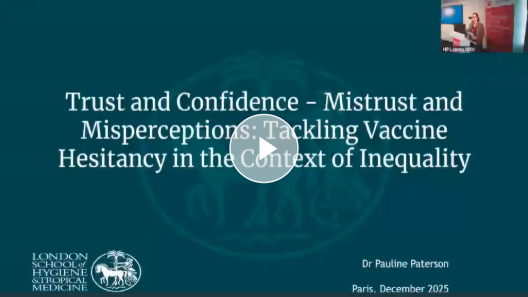
Key Points from the Briefing
Three insights Dr. Paterson’s briefing showed about how vaccine confidence is built and how it is lost:
Vaccine confidence is inseparable from institutional confidence
When trust in government and public health institutions declines, vaccination confidence falls with it. Political instability, inconsistent messaging, and perceived failures all affect the uptake.
Frequent changes in guidance undermine credibility even when the science is sound
Inconsistent or rapidly changing guidance can lead communities to conclude that “they don’t really know.” The credibility cost is high and slow to recover from.
Trust cannot be fixed with messaging; it has to be earned through system performance
The same conditions that create access barriers and under-resourced systems also erode trust. Rebuilding confidence requires rebuilding systems.
About the Campaign
The EiP Vaccination Equity Campaign shares the findings of the December 2025 LifeCourse Prevention Summit, which examined why vaccination inequities persist and what must change. The Summit produced shared commitments and an Action Framework for vaccination equity, which this campaign makes public, amplifies, and invites a wider community to act on.

This campaign was developed in collaboration with Pfizer. The December 2025 LifeCourse Prevention Summit Meeting Report was produced through a partnership between the Excellence in Pediatrics Institute and Pfizer.
Rue des Vignerons 1B, 1110 Morges (VD), Switzerland
secretariat@ineip.org
