
Excellence in Pediatrics is a non-profit association dedicated to advancing pediatric healthcare.
Rue des Vignerons 18, 1110 Morges 1 (VD), Switzerland
email: secretariat@ineip.org
tel. +41 43 21 55 937



This Issue
The single most important fact about RSV: this virus does not confine its most serious consequences to high-risk groups only. Most infants who were put in intensive care were otherwise healthy.
Context
RSV (Respiratory Syncytial Virus) is the leading cause of lower respiratory tract infection in infants and young children worldwide. It causes 33 million lower respiratory tract infections and more than 3 million hospitalizations in children under five, every year. In Europe alone, more than 200,000 children are hospitalized annually, with over 75% of admissions occurring in infants under one year of age. It is the most common cause of bronchiolitis, and a virus that has been widely underestimated as a cause of severe disease.
The most consequential misconception in RSV prevention is about who could get seriously ill. For years, clinical practice and policy focused primarily on the protection of preterm infants and those with underlying chronic conditions. While this focus is justified, it is incomplete. Evidence shows that the majority of RSV hospitalizations and pediatric intensive care admissions occur in otherwise healthy, full-term babies. This is not a virus that confines its most serious consequences to the margins. It is a virus that hits the mainstream.
This matters profoundly for prevention design. Strategies that target only infants identified as high-risk will, by definition, leave the majority of infants unprotected. The data are unambiguous: universal prevention strategies consistently outperform targeted ones.
There is also a timing dimension that can easily be missed. Roughly half of all infants hospitalized with RSV were born before the RSV season began. They are out-of-season births who enter the season as they grow, with no protection in place. A prevention program focused only on infants born during the season will miss approximately half of those at risk. Universal protection means exactly that: every infant, born at any time, receives protection before their first RSV season.
The first newsletter of the EiP RSV Prevention Campaign sets out these fundamentals and what follows: which prevention strategies work, how to implement them to achieve high coverage, and how to make the case that an otherwise healthy infant still needs protection.
Featured Interview

Key Points from the Interview
Five key insights Prof. Philip’s work and experience reveal about RSV and the case for universal infant protection:
The zero-to-six-month window is a period of heightened immunological vulnerability
In early infancy, waning maternal antibodies and an immature immune system leave infants vulnerable to RSV-related respiratory distress; a predictable risk that prevention programs can directly address.
Severe RSV disease occurs in otherwise healthy infants, not just the fragile
Targeting only high-risk groups misses most cases, and you cannot predict which infant will become critically ill, making this the argument for universal protection.
Breastfeeding provides meaningful but incomplete protection
Exclusive breastfeeding for 4 months or more reduces RSV severity and hospital burden. However, breastfeeding alone is not sufficient. The message to families should be: breastfeed if you can, and immunize regardless.
‘RSV March’ is a transmission pattern that has direct implications for prevention planning
RSV spreads from toddlers in childcare to infants at home, and to older adults. Data show a 3–5 week lag between peak toddler and elderly infections. Understanding this transmission cascade supports planning and highlights that protecting infants benefits the entire family.
Ireland’s Pathfinder program demonstrates what high-coverage universal prevention looks like in practice
Ireland’s Pathfinder program reached 90% coverage within months, reducing pediatric admissions by 70–74% and critical care transfers by 90%. Midwife-led delivery of nirsevimab before discharge made the program effective.
The Report
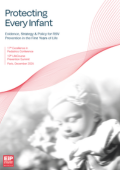
“A strategy that targets only high-risk infants will, by definition, leave the majority of vulnerable children unprotected. The data support the need for extended protection of all infants.”
Protecting Every Infant — EiP RSV Policy Report 2025, p. 4
From the Summit Briefings
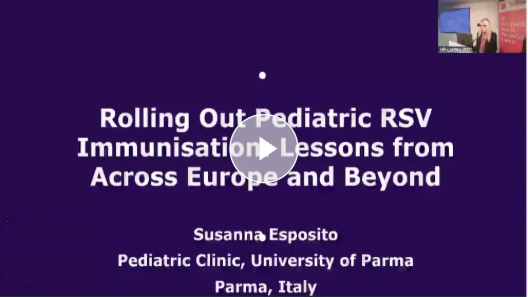
Key Points from the Briefing
Three insights from Prof. Esposito’s briefing outline the current RSV prevention landscape:
There is currently no RSV vaccine for direct infant immunization
Infant RSV vaccines are still in development, leaving maternal vaccination and monoclonal antibodies as the available options. These are the tools, and their effective use is what clinicians and health systems must now master.
Out-of-season births account for roughly half of RSV hospitalisations
Infants may enter their first season without adequate maternal protection; monoclonal antibodies given at season’s start can bridge this gap.
Monoclonal antibodies co-administered with routine vaccines enable scalable implementation
Previously, nirsevimab required a separate visit, increasing missed opportunities. Integration with routine vaccines enables delivery at scale, driving Ireland’s 90% coverage.
About the Campaign
The EiP RSV Prevention Campaign presents the findings of the December 2025 LifeCourse Prevention Summit and the 17th Excellence in Pediatrics Conference, where experts reviewed the evidence on RSV burden and prevention. These discussions informed the policy report, “Protecting Every Infant,” which outlines practical recommendations for clinicians, health system leaders, and policymakers.

This campaign was developed in collaboration with Sanofi. The “Protecting Every Infant” policy report was produced by the Excellence in Pediatrics Institute, based on expert discussions at the 2025 LifeCourse Prevention Summit and the 17th Excellence in Pediatrics Conference (Paris, December 2025).
Rue des Vignerons 1B, 1110 Morges (VD), Switzerland
secretariat@ineip.org
