
Excellence in Pediatrics is a non-profit association dedicated to advancing pediatric healthcare.
Rue des Vignerons 18, 1110 Morges 1 (VD), Switzerland
email: secretariat@ineip.org
tel. +41 43 21 55 937



This Issue
Vaccination equity starts with a question we do not ask often enough: “Why does the system fail the communities it serves?”
Context
When vaccination rates fall in communities facing the greatest barriers to access, the explanation offered is often the same: hesitancy. The term has become so pervasive that it shapes how programs are designed, how resources are allocated, and how communities are understood. Yet the evidence presented at the December 2025 LifeCourse Prevention Summit tells a different story.
Vaccination inequities are not random, but they follow patterns linked to poverty, housing insecurity, access to services, and people’s experiences with public institutions. What is often described as ‘hesitancy’ reflects families navigating structural barriers to vaccination access. Trust in vaccination is inseparable from trust in institutions, and where services are experienced as inconsistent or unresponsive, skepticism is a rational response.
Through the EiP Vaccination Equity Campaign, we examine what equity requires: from rebuilding institutional trust, to co-designing programs with the communities they are meant to serve, to the structural policy changes needed for equitable vaccination coverage.
The LifeCourse Prevention Summit produced a set of commitments and an Action Framework for vaccination equity, which will be explored in the coming newsletters.
Featured Interview
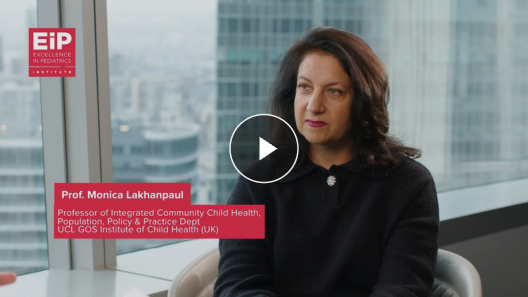
Key Points from the Interview
Five insights from Prof. Lakhanpaul’s interview that challenge how we think about vaccination and trust:
Every parent wants their child protected
Parents want their children vaccinated, but the gap between intention and action reflects the obstacles to accessing and completing a vaccination appointment.
Mistrust is earned, not chosen
Repeated experiences of systems that do not work lead to mistrust. Mistrust cannot be overcome with just a leaflet or a campaign alone.
Trust is built through relationships, not transactions
Community facilitators, embedded within their communities, are often more effective at opening vaccination conversations because trust already exists.
Mobile and migrant families are systematically invisible
Children in underserved populations have low vaccination coverage but remain largely invisible in policy data. Without data, there is no intervention, and inequity compounds.
The problem lies in how accessible the system is
The ‘candidacy framework’ highlights the complex journey to vaccination. For many families, the system is not just difficult; it is structurally inaccessible.
The Report
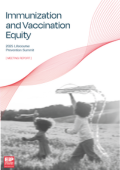
“Mistrust often emerges as a rational response to the lived experience of inaccessible or inconsistent systems, rather than individual reluctance.”
2025 LifeCourse Prevention Summit Meeting Report, p. 2
From the Summit Briefings
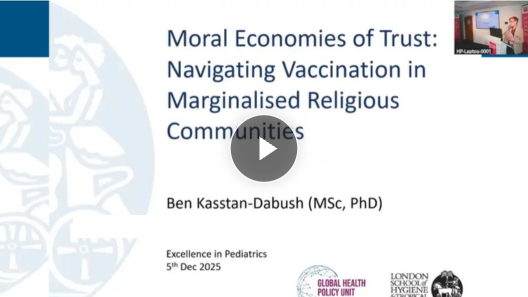
Key Points from the Briefing
Three insights from Dr. Kasstan-Dabush’s briefing showed us how vaccination decisions are really made:
Religion is not a barrier, but institutional failure can be one
No major religious tradition forbids vaccination. When religion is cited, it usually reflects exclusion, poor engagement, or services not designed for the communities they are meant to reach.
Vaccination decisions live in peer networks, not institutional hierarchies
Vaccination decisions are shaped by peer networks, not by religious or other institutions. Engagement strategies that miss this will miss where decisions are actually made.
Culturally adapted approaches can reinforce the very inequities they aim to address
When ‘cultural sensitivity’ lacks real community insight, it risks deepening exclusion. Effective approaches treat communities as partners, not challenges.
About the Campaign
The EiP Vaccination Equity Campaign shares the findings of the December 2025 LifeCourse Prevention Summit, which examined why vaccination inequities persist and what must change. The Summit produced shared commitments and an Action Framework for vaccination equity, which this campaign makes public, amplifies, and invites a wider community to act on.

This campaign was developed in collaboration with Pfizer. The 2025 LifeCourse Prevention Summit Meeting Report was produced through a partnership between the Excellence in Pediatrics Institute and Pfizer.
Rue des Vignerons 1B, 1110 Morges (VD), Switzerland
secretariat@ineip.org
